I've run many manufacturing lines in the past, and seen hundreds more, including some exemplary examples of lean while visiting companies in Japan. A fundamental lesson I've observed and learned is that the best operations leverage the power of the brains of the operators, and that can sometimes mean using methods and equipment that may be superficially and incorrectly deemed as inefficient, such as using smaller, single-operation equipment instead of large automated lines.
It really revolves around a concept I embrace: a process that yields good parts while eliminating the operator's ability to improve the process is still a bad process.
You must retain the ability to perform kaizen.
Let's talk automation... and humans
Toyota's own account of jidoka, automation with a human touch, puts the sequence plainly. Before you replace an operation with a machine, you have to be able to do the work smoothly and correctly by hand, learn to spot the abnormalities, and run kaizen on it. Starting with the machine gets the order backwards.
In The Road Ahead, Bill Gates said automation applied to an efficient operation magnifies the efficiency, and automation applied to an inefficient operation magnifies the inefficiency, and the line has been on conference slides for 30 years.
Mitsuru Kawai took that even further. An Ohno disciple who spent 40 of his 50 Toyota years in forging, he stopped automation in places at the Honsha plant and put skilled workers back on the processes by hand, because running the work manually produced the kaizen ideas he needed for when the machine was rebuilt. The lines came back less complex. A senior technical executive at Toyota removing automation to recover something the automation had killed: human knowledge, while also improving flexibility and reducing fixed costs.
Lisanne Bainbridge arrived at the same place from process control. Her 1983 paper in Automatica, "Ironies of Automation," argues that once you automate most of a system the operator keeps responsibility for the part you couldn't automate while losing the practice that part requires. Her closing irony: the automated systems that run longest without needing a human are the ones eventually demanding the largest investment in human skill.
What actually happened with calculators
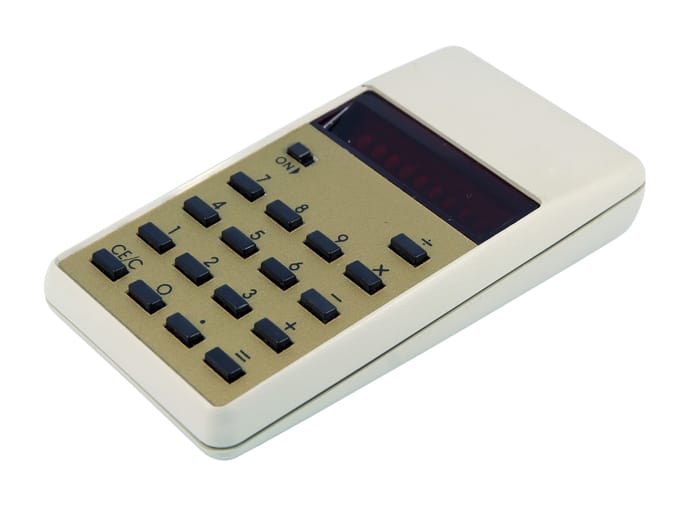
A similar situation with equipment replacing brains happened when calculators became a thing in the 70s and there was panic among educators (sounds familiar? we'll get to AI in a minute). Tests required no calculators, kids would still try to sneak smaller and smaller calculators into class, and over the next decade scientific and graphing calculators took the concern to a new level. Kids would forget arithmetic, the reasoning went. And then they didn't. We turned out ok. And the HP-15c calculator I used in college in the early 80s is still my favorite. Long live reverse Polish notation!
That question was studied hard. Ray Hembree and Donald Dessart pulled together 79 research reports in 1986 and found that at every grade except the fourth, calculator use alongside traditional instruction improved students' paper-and-pencil skills, in working exercises and in problem solving. Attitudes improved too. So the panic was wrong.
It gets better. The gains clustered in studies where the calculator was built into a curriculum designed around it rather than handed out as a shortcut, and the exception was sustained use in fourth grade, the year the underlying arithmetic was still forming. A 2026 paper in Technology in Society by Cristina Voinea and colleagues goes back through those debates and lands on an interesting point:the impact of calculators was shaped less by the device than by the pedagogy it was dropped into. We redesigned the surrounding system, and it worked everywhere the skill was already there to be offloaded.
Here comes AI...
Many believe AI is having a similar impact on knowledge. A multicenter study in Lancet Gastroenterology & Hepatology in August 2025 followed 19 experienced endoscopists in Poland, each with more than 2,000 colonoscopies behind them, after their centers adopted AI polyp detection. On the colonoscopies they later ran without the AI, adenoma detection fell from 28.4% to 22.4%. Just three months of AI assist, with experienced experts.
And consider the basic Google search, and how it has evolved in just the last few months. No longer do we scan the list of links, applying some brainpower to determine which is most applicable and then reading the content at the link to see if it's an answer. Instead Gemini gives us an answer, perhaps with references, and more often than not we simply accept that answer. Only occasionally we dive deeper into the page of links, let alone question the answer provided by AI.
Voinea's 2026 paper on LLMs that uses calculators as an analogy is also where the analogy runs out. A calculator takes a problem you've already framed and hands back a number you know how to read. AI language models redistribute the work across every stage of the reasoning, from deciding what the question is to judging what the answer means, and they deliver it in prose fluent enough to feel true either way. The calculator couldn't tell you what to solve.
The Tao of Navier-Stokes
Scale that up and you get the reaction to OpenAI's claimed proof of the Navier-Stokes existence and smoothness problem, one of the seven Millennium Problems, announced last week. Terence Tao told the Times,
The effort needed to solve problems is often very instructive. It teaches you something. It’s like going to the gym and having a goal to lift a weight a hundred times,” he explained. “Now, A.I. can solve questions without really getting any value out of them. It’s like having machines that can lift weights for you at the gym.
Quanta profiled him in June under the title "How Terry Tao Became an Evangelist for AI in Math," he writes his own proofs in software that machine-checks every step, and he used AI tools to help prepare the essay I'm about to quote.
That essay, from his ICM lecture in July and written three weeks before the OpenAI announcement, refuses to argue about capability at all. He assumes the tools arrive, then asks what the goals of mathematical research actually are, and finds that "solve unsolved problems" was always shorthand for a chain: generate a proof, verify it, write it up so a human can follow it, get the community to absorb it, and eventually fold it into the definitive theory of the field. Only the first stage was ever an explicit goal. The rest ran along behind it reliably enough that nobody had to name them.
Then he reaches for Goodhart's law, which got me scratching my head. When a measure becomes a target it stops being a good measure, and a tool optimizing hard on the one stage we chose to measure will pull the other stages away from it.
His sharpest point is about friction. A proof written by a human keeps the scars of wherever the author struggled: an apologetic aside, an unusually careful lemma, a change of notation halfway through. He reproduces a page of a 1991 Bourgain paper covered in his own frustrated annotations, and says that fighting through texts like that is how he came to think the way Bourgain thought. The friction tells you where to slow down, and it's one of the few channels by which the tacit knowledge of a field moves from one head to another. Machine-polished prose sands it off. What's left reads beautifully and teaches nothing.
So his rule of thumb has nothing to do with checking the math. If the authors can't give a clear, expert-level talk on their own result, it shouldn't be published, and a proof no human can explain should count as incomplete however cleanly the software verifies it. That's an andon cord with a mortarboard on.
The survey work tying heavy AI use to weaker critical thinking is correlational and self-reported, and the International AI Safety Report calls the area nascent. But a March 2026 synthesis from the University of Technology Sydney flags the split underneath: people with solid domain knowledge use these tools to go faster, and people without it are the ones most exposed. Fourth grade again.
Kaizen is a training system that makes parts on the side
That's the thread running through all of it. A math department produces theorems the way my factory produced parts, and both of them are actually running an education process with a production process on the outside. The Polish endoscopy centers were doing the same thing without knowing it, right up until they weren't. Every one of them keeps producing acceptable output long after the capability behind the output has started to go, which is precisely what makes it hard to catch.
How do we keep humans and brains engaged in processes so we can improve, and understand, what is going on?