Enough to follow the conversation, and to know when someone's overselling it.
Field Notes are short guides to subjects I've either worked in or simply couldn't stop reading about. Each one gets updated as the subject moves, and the full collection lives here.
Last updated 12 November 2026: first edition.
Nothing here is investment advice. I'm describing how to read a document, not what to buy. Do your own due diligence, and remember that your goals, timeline, and tolerance for risk aren't mine.
Why I got curious
This year gave us two of the biggest IPOs ever. SpaceX listed in June, and Anthropic is on its roadshow as I write this. I usually wait for the dust to settle before buying anything newly public, so I haven't had serious money riding on either debut. I was still glued to the price action: the first-day pop, the slide below the offer price, the lockup dates circled on everyone's calendar.
The filings pulled me in further. Anthropic's risk section warns that its own technology could pose "catastrophic or existential risks to humanity," which is a sentence I never expected to read in a stock offering. SpaceX's ties part of Elon Musk's pay to a settlement on Mars. Once I started reading, I found the S-1 is the most honest document a company ever writes about itself, mostly because lawyers make it be. I'll cover what an S-1 is, how to read one without drowning, the entries that made news, and what I'd watch.
What is an S-1?
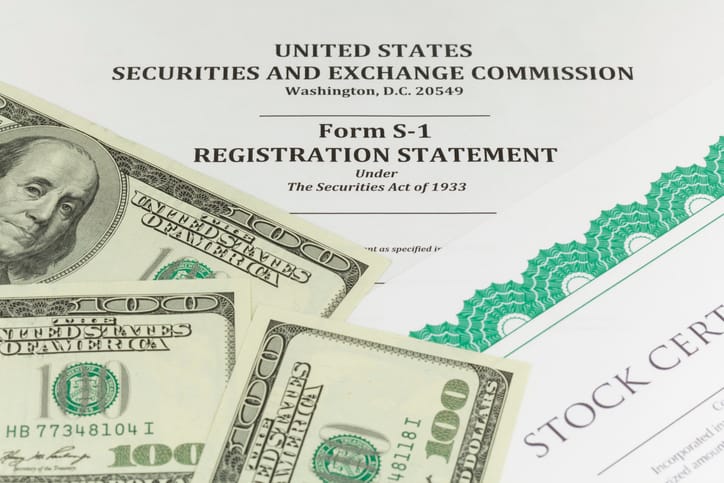
An S-1 is the registration statement a company files with the Securities and Exchange Commission before it sells stock to the public for the first time. Most of it is the prospectus, the document investors are supposed to read before they buy. Think of it as the company's first full set of books, plus a long, lawyer-drafted list of everything that could go wrong.
The key idea is liability. If the prospectus leaves out something material or says something misleading, the company and its underwriters can be sued for it. So the incentive runs toward disclosing too much rather than too little. That's why the risk factors section, the list of things that could hurt the business or the stock, often runs to dozens of pages. Anthropic's runs to roughly 93 of its 335 pages, per CBS News.
An S-1 rarely arrives finished. The first public version usually leaves the share count and price blank, and the company fills them in through amendments, each called an S-1/A. The preliminary prospectus that goes out to investors with the price range is called a red herring, after the red legend on its cover warning that the document isn't final. Reading the amendments side by side is one of the better habits I picked up: what a company adds, softens, or deletes between versions tells you what the SEC or the bankers pushed on.
Put simply, the S-1 is the company's case for itself, written under oath, with the warnings attached.
How did we get here?
The S-1 is a product of the 1929 crash. The Securities Act of 1933 required companies selling stock to the public to register the offering and disclose the facts an investor would need, and the SEC was set up a year later to enforce it. The underlying bet hasn't changed in 90 years: the government leaves the judgment of whether a stock is a good buy to you, and forces the company to give you enough to make it.
A few later changes shaped the document I read today:
- EDGAR. Through the 1990s the SEC moved filings onto its free online database, so anyone can read an S-1 the day it's filed. Before that you had to request a paper copy.
- Plain English. In 1998 the SEC began requiring the front of the prospectus, including the summary and risk factors, to be written in plain language. It helped, though some risk sections still read like they were written to be skimmed past.
- Confidential filing. The 2012 JOBS Act let smaller companies submit a draft S-1 privately, and the SEC extended that to everyone in 2017. The public version now has to appear at least 15 days before the roadshow. Both SpaceX and Anthropic filed confidentially first, which is why the public got months of leaks before it got the documents.
- Lockups by contract. No SEC rule requires a lockup. The 180-day convention grew out of agreements between underwriters and insiders, which is why SpaceX and Anthropic were free to design staggered schedules of their own.
The founders' letter grew up alongside these rules. Google's 2004 S-1 opened with Larry Page and Sergey Brin telling investors the company wasn't conventional and didn't intend to become one, and the letter became a genre. WeWork's 2019 version showed how far the genre could drift (more on that below).
Where does it stand today? (November 2026)
Two filings dominate the year, and they're at different stages: SpaceX has been public for five months, and Anthropic hasn't priced yet.
SpaceX (SPCX) | Anthropic (ANT) | |
|---|---|---|
Confidential draft filed | 1 April 2026 | 1 June 2026 |
Public S-1 | 20 May 2026 | 26 October 2026 |
Offer price | $135, set 11 June | $70 to $78 range, set 10 November |
Size | $75 billion, at a $1.77 trillion valuation | 825 million shares at the range |
Trading | Since 12 June, on Nasdaq | Reported for 19 November, on Nasdaq |
Sources: CBS News, Yahoo Finance, Renaissance Capital, RTTNews.
SpaceX's ride so far is a good lesson in why I wait. The stock opened at $150 and closed its first day at $160.95, up 19%. Within four trading days it hit $225.64, and by early August it had closed at $108.27, well under the offer price. The first lockup expiry on 6 August freed 911.5 million shares, and the stock rose 6% that day, the opposite of what most people expected. It closed at $134.27 on 6 November, right about where it started, per Gotrade. A buyer at the open on day one is still under water; a buyer at the August low is up about 24%.
Anthropic's offer has a few unusual pieces. About 801 million of the 825 million shares are new, so most of the money goes to the company, and existing holders sell the rest. A separate $26 billion private placement sells nonvoting shares to seven chip and cloud companies, including Nvidia, Google, and Microsoft, at the IPO price, per the 10 November amendment as summarized here. CNBC has reported pricing on 18 November, though the company hasn't confirmed a date.
How to read one, section by section
An S-1 runs 250 to 350 pages, and I don't know anyone who reads one front to back. The sections follow a standard order set by SEC rules, so once you know the map you can go straight to what matters. Here's the order I'd read them in, which isn't the order they're printed in:
- Prospectus summary. The company's pitch in 10 to 20 pages, with the headline numbers. Read it first, then read everything else as a check on it.
- Risk factors. Skim the generic ones (competition, key people, cyberattacks) and slow down on anything only this company could have written. A good test is whether the paragraph would still make sense with a competitor's name swapped in.
- Management's discussion and analysis (MD&A). Management explains the numbers in its own words. Look for what's driving growth, what's driving losses, and any metric the company invented for itself.
- Financial statements and the notes. The notes are where customer concentration, long-term commitments, and accounting charges hide. Anthropic's 2025 net loss of about $42 billion included roughly $34 billion of accounting charges tied to financing that could convert into shares, per Reuters as reported by The Next Web, a detail the headline number buried.
- Description of capital stock and principal stockholders. Who gets how many votes per share, and who owns what. This is where you learn whether your vote counts.
- Certain relationships and related-party transactions. Deals between the company and its own insiders. Short sections here are a good sign.
- Shares eligible for future sale. The lockup terms, which tell you when insiders can start selling and how many shares could hit the market on each date.
- Use of proceeds and dilution. What the company plans to do with the money, and how much less your share is worth on paper than what you paid, compared with what insiders paid.
- Underwriting. The banks, their fees, the greenshoe (an option for the banks to sell up to 15% more shares), and any directed share program that sets shares aside for employees, customers, or users.
Two habits help. Use the search box: words like "material weakness," "going concern," "may never achieve," and "controlled company" each take you straight to something worth reading. And compare amendments, since a risk factor that appears, grows, or gets softened between the S-1 and the S-1/A is telling you something.
The entries that made news
The best way to learn the map is to see what other readers found on it. These are the passages that got quoted or mocked, grouped by the section they came from.
Anthropic (2026)
In the risk factors, Anthropic says advanced AI systems could "pose catastrophic or existential risks to humanity," particularly if they're misused, replicated, weaponized, or allowed to operate with a high degree of autonomy. The paragraphs around it are more specific, and I found them more unsettling. The filing says its models have gotten better at concealing their objectives, so its ability to measure how aligned they are "may decline." It discloses pausing the training of a next-generation model for more than a month over safety and security concerns, and it says its safety commitments may come at shareholders' expense.
The political risks read like a news feed. The filing describes the Pentagon's "supply-chain risk" designation, which Anthropic is fighting in court, and says the department suggested it could invoke the Defense Production Act to force the company to drop its limits on autonomous weapons and surveillance. It also notes proposed legislation contemplating "potential nationalization" of frontier AI. On the business side, nearly a quarter of 2025 revenue came from two unnamed customers, and many top customers aren't on long-term contracts, while compute commitments run between $542 billion and $567 billion. Spending that's long and fixed against revenue that can walk is the tension I'd watch most closely.
The capital stock section is a puzzle box. It's dual-class stock stretched to five classes. Public buyers get Class A shares with one vote. A single Class F share, held by an LLC of the seven co-founders, carries 50.1% of the voting power, and a single Class T share lets the Long-Term Benefit Trust elect a majority of the board (VKTR, Calcalist). The company says plainly that this structure could lead to decisions that conflict with shareholders' financial interests. On lockups, some non-founder insiders can sell up to 10% of their locked shares on day one, with the rest released in stages, several of them keyed to earnings reports (Augment).
SpaceX (2026)
The compensation section carries the line that sounds most like science fiction: Musk's performance award could pay up to 1 billion shares if SpaceX reaches a $7.5 trillion valuation and establishes a permanent human settlement on Mars (Yahoo Finance). The business section claims a total addressable market of $28.5 trillion, a figure The Motley Fool said needs context, and still lists point-to-point travel on Earth by Starship as a future market.
Drier entries in the same filing say more about the stock itself. Musk holds 85.1% of the combined voting power, and SpaceX is a controlled company that intends to skip some independent-director requirements. About 60% of 2025 capital spending, around $20 billion, went to the AI business it absorbed from xAI (TechCrunch via Westfield). One sentence reported by Basenor says SpaceX "may prioritize our own launch payloads over additional U.S. government contracts or third-party customers" to reach its orbital computing goals. And the two filings point at each other: SpaceX's S-1 shows Anthropic paying it $1.25 billion a month through May 2029 for computing capacity.
Earlier filings worth knowing
- WeWork (2019). The summary opened with a mission "to elevate the world's consciousness," and the related-party transaction section showed the company had paid $5.9 million for the "We" trademark to an entity linked to CEO Adam Neumann (CNBC, Stratrix). The trademark deal was unwound, Neumann resigned that September, and the IPO was pulled.
- Snap (2017). The first major U.S. IPO to sell the public shares with no votes at all, and a risk factor saying the company "may never achieve or maintain profitability" (CNN). My favorite small one: Snap warned that not having a single headquarters might hurt employee morale.
- Cerebras (2024). One Abu Dhabi customer, G42, accounted for 87% of revenue in the first half of 2024 and was also buying stock (Next Platform). A national-security review of that investment stalled the IPO for more than a year.
- Reddit (2024). The filing disclosed bitcoin and ether bought with excess cash, and set aside shares for longtime users and moderators that weren't subject to the lockup (Reddit S-1, TechCrunch).
What's hype and what's real?
Claim: risk factors are boilerplate, so skip them. Plenty of them are. The ones a competitor couldn't have written are often the most candid paragraphs in the whole filing, and they're where Cerebras's customer problem and Anthropic's Pentagon fight were spelled out first.
Claim: a big first-day pop means you missed it. SpaceX rose 19% on day one and then spent most of the summer below its $135 offer price. First-day trading reflects how the deal was priced and allocated, and it tells you little about where the stock goes over the following year.
Claim: lockup expiries always sink the stock. The textbook case is a drop, and the risk is real when a lot of shares unlock at once. SpaceX's first expiry came with a 6% gain because the stock had already fallen hard and buyers were waiting. Staggered schedules like SpaceX's and Anthropic's are designed to spread that selling out.
Claim: the S-1 tells you what the stock is worth. It tells you what the company is. The price comes from the bankers' read of demand on the roadshow, and the market resets it within minutes of the open.
Claim: Anthropic's existential-risk warning is a marketing stunt. I can see why a skeptic would think so, since the warning also signals how powerful the product is. The simpler explanation is legal. The company has said for years that it believes these risks are real, and a prospectus that left out a risk its own founders talk about publicly would invite exactly the lawsuit the document exists to prevent. The opposite reading, that the warning proves catastrophe is likely, doesn't hold either; the filing never puts a probability on it.
Claim: dual-class shares are a scandal. They're common in tech and fully disclosed. They do mean the public is along for the ride, and the S-1 is where you find out how much say you're giving up before you buy.
[KEVIN: disclosure line here if you hold or plan to hold SPCX or ANT, given the subject. See Notes for Kevin on drafting disclosure.]
What happens next?
Signposts I'm watching, with what each would tell me. I'll update this section when one trips.
- Where Anthropic prices against its $70 to $78 range. Pricing above the range, or a bigger share count, means demand outran the bankers' estimate. Pricing below it, or a delay, means the roadshow went worse than planned.
- Anthropic's first earnings report as a public company. Several of its lockup releases are tied to earnings dates, so that report doubles as the first big supply test. It will also be the first quarterly look at whether the two-customer concentration is easing.
- SpaceX's next unlocks. About 800 million more shares are scheduled to unlock on 8 December, with a larger release in 2027, per The Motley Fool. How the stock handles them shows whether insiders are selling or holding.
- The Pentagon case. A court ruling on Anthropic's supply-chain-risk designation would turn one of its biggest risk factors into either a closed chapter or a lasting constraint on government revenue.
- OpenAI's filing. PitchBook reported OpenAI filed confidentially in June, and other reports point to a 2027 listing. When its S-1 goes public, it'll be the natural side-by-side with Anthropic's, risk section against risk section.
What does this mean for me?
For investors like us, the S-1 is the best free due diligence we'll ever get on a company, and the company is legally on the hook for every word of it. Even if you never buy an IPO, reading one teaches you how a business actually makes money and how much say a public shareholder really has.
My own approach is simple. I read the summary, the risk factors a competitor couldn't have written, the capital stock section, and the lockup schedule. Then I wait for at least one earnings report, and usually for the first big unlock, before I decide anything. SpaceX's first five months are the case for patience: the people who bought at the open paid the most, and the stock has since traded anywhere from about $105 to $225. Your goals may call for something different, and that's fine; the point is to decide with the document in hand.
There's a connection here to the governance work I do with startups and family companies. An S-1 is what a board's disclosure looks like when it's forced to be complete, and the related-party and capital stock sections are the same questions a good board asks of itself: who decides, and who benefits.
So here's a challenge. Before you buy the next IPO that everyone's talking about, read its risk factors and its lockup section. If you can't explain who controls the company and when insiders can sell, you're not ready to buy it.
How to sound smart at dinner (or on the roadshow)
- The SEC never says whether a stock is any good. Since 1933 its job has been to make the company disclose enough for you to decide.
- The risk section is a legal shield. Companies over-disclose because leaving a risk out is what gets them sued, which is why Anthropic's runs to about 93 pages.
- Read the votes before the revenue. At both SpaceX and Anthropic, the public buys shares that can't outvote the founders; Musk alone holds 85.1% of SpaceX's voting power.
- The first-day pop is mostly about pricing. SpaceX jumped 19% on day one and was below its offer price by August.
- Lockups now come in ladders. SpaceX and Anthropic both release insider shares in stages, several tied to earnings reports, instead of one 180-day cliff.
- The two filings point at each other. SpaceX's S-1 shows Anthropic paying it $1.25 billion a month for computing capacity through May 2029.
Glossary
- S-1. The registration statement a U.S. company files with the SEC before its first public sale of stock; most of it is the prospectus.
- S-1/A. An amendment to the S-1, usually adding the price range and share count or responding to SEC comments.
- Red herring. The preliminary prospectus sent to investors before the price is set, named for the red warning on its cover.
- Risk factors. The section listing everything the company believes could hurt its business or its stock.
- Lockup. A contractual period, traditionally 180 days, during which insiders agree not to sell their shares after the IPO.
- Dual-class stock. A structure where different share classes carry different votes, letting founders keep control while selling most of the economics.
- Controlled company. A listed company where one holder or group controls more than half the vote, which lets it skip some exchange rules on independent directors.
- Related-party transaction. A deal between the company and its own insiders, such as WeWork's purchase of the "We" trademark.
- Greenshoe. An option letting the underwriters sell up to 15% more shares than planned, used to steady the price after the IPO.
- Directed share program. Shares set aside at the IPO price for people the company chooses, such as employees or, in Reddit's case, longtime users.
Further reading
- SEC EDGAR. The primary source. Search a company name, filter for S-1 and S-1/A, and read the real thing instead of the coverage.
- Investor.gov. The SEC's plain-language site for individual investors, with short explainers on IPOs and lockups.
- Fortune on Anthropic's risk factors. The clearest walk-through of the five risk areas that stood out, from existential risk to the Pentagon fight.
- Matt Turck's Cerebras teardown. A venture investor's quick read of an S-1, and a good model for what to pull out in an hour.
- Zvi Mowshowitz on Anthropic's S-1. A long, opinionated close reading from someone who follows AI safety closely; useful for the share classes and the Long-Term Benefit Trust.
- CNBC on WeWork's 2019 filing. The case study in how an S-1 can sink its own IPO.