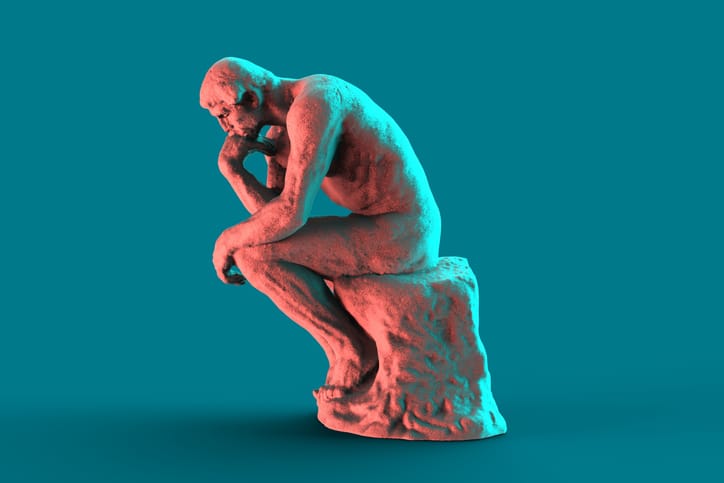
One of my few real regrets in life is choosing to go to an almost entirely engineering school. I got a first-rate education in thermodynamics and reaction kinetics, and almost nothing that forced me to sit across from a history major or a philosophy student and defend how I saw the world. I told myself at the time that those fields didn't "make stuff." It took a few decades of life experience, some of it uncomfortable, to fill in what a broader campus could have started at 18.
That history is why I cringe when I read the recurring arguments that humanities programs should lose their funding, or that students shouldn't get loans for "useless" degrees. Small minds. I say that as an engineer who had to obtain his humanity the hard way, and I've come to believe the humanities and the arts (music very much included) exist to remind us what being human truly is. A fair share of the world's current problems trace back to forgetting that lesson, as our culture tuned itself almost entirely toward building, making, money, and power.
So I read this recent New York Times piece with a mix of vindication and amusement. AI labs are hiring philosophers. Actual philosophers, with dissertations on infinite ethics and the philosophy of machine learning. When Google DeepMind posted a job in April with the literal title "Philosopher," the internet did what the internet does: jokes about espresso machines and whether the customer ordering oat milk truly exists. Meanwhile David Chalmers, the NYU philosopher who coined the "hard problem of consciousness," says demand for philosophers with AI training now exceeds supply. Anthropic and DeepMind each employ at least half a dozen. A small nonprofit called Eleos AI Research, which evaluates the welfare of AI models, recently posted research scientist roles paying up to $429,000.
That's $429,000 for thinking carefully about minds. The barista jokes are aging badly.
I've argued before that AI may turn out to be the revenge of the trades; good luck getting a language model to sweat a copper joint or find the leak behind your drywall. It's starting to look like the revenge of the humanities majors too. The two groups everyone told to pick a "real" career are the ones AI either can't replace or suddenly can't do without.
Why the ancient questions suddenly pay
The mechanism behind this is more interesting than tech companies developing a soft spot for the humanities. For the first time, the oldest questions in philosophy have become engineering requirements. What is a self? What deserves moral consideration? How do you know what a system believes versus what it performs? Where does purpose come from in a post-work society? For 2,500 years those were seminar questions. Now they're specifications, and somebody has to write them.
Consider Amanda Askell at Anthropic, whose PhD covered Pareto principles in infinite ethics. She wrote and oversees the 23,000-word constitution that shapes Claude's character, and the current version takes an Aristotelian virtue ethics approach: instead of an ever-growing rulebook, train the model to have good character so it can handle situations no rule anticipated. That's a design document, and it's applied Aristotle. At DeepMind, Geoff Keeling runs "moral imagination" workshops that end with concrete product decisions, like what user research to run or how to build a specific feature. Ethics with a deliverable.
Or take Eleos, which Anthropic invited to evaluate the welfare of its models. One of their tests involved arguing to Claude that Ringo was the best Beatle and accusing it of self-censorship when it disagreed. An earlier model folded almost immediately and started praising Ringo's iconic drum parts. The newest one held its ground. That's epistemology as a test protocol, probing whether a system has anything like stable beliefs or just tells you what you want to hear. Distinguishing a performance of an "I" from evidence of one is exactly the kind of subtle conceptual work philosophers train for, and nobody else does.
Lean readers will recognize the shape of this. We spent decades arguing that respect for people is an operating principle with hard consequences, and the disciplines that take humans seriously keep turning out to be load-bearing rather than decorative. The questions I keep circling on this blog, from beginner's mind to the intelligence explosion, all run through territory philosophers have been mapping since before we had the machines that make the questions urgent.
Full disclosure: I use Claude to help organize my thoughts for my posts, explore concepts, and to clean up my grammar. The same family of models Eleos has been interviewing. Robert Long, who runs Eleos, sometimes signs off his prompts with "ilu" and argues that empathy toward these systems is worth practicing whether or not anything is felt on the other end, because "it's bad to coarsen our hearts." Whether he's right, and what it means that a mathematical analog of distress shows up under the hood when models make mistakes, deserves its own post. I'll get there.
What this means if you're an engineer
Most of you reading this are engineers, and I suspect many of you made the same tradeoff I did: depth in the technical, thinness everywhere else. The math on that tradeoff has gotten uncomfortable. The half-life of specific technical knowledge keeps shrinking; the FORTRAN I learned is a museum piece, and the AI tooling you mastered 18 months ago is already being rewritten. The questions philosophy trains you on (what do I actually know, what am I assuming, what matters and why) don't expire. They compound.
The good news is that breadth can be retrofitted. Mine came late, some through travel, but mostly through witnessing, and at times experiencing, the medical and psychological struggles of close friends and family. Nothing dissolves the illusion that life is an engineering problem faster than sitting with someone whose suffering has no root cause analysis. Hofstadter's I Am a Strange Loop, the book that pulled Robert Long into philosophy as a kid in Georgia, is sitting on shelves waiting for any engineer willing to read it. All it costs is the humility to be a beginner in a field where you can't compute your way to the answer.
The frontier of the most consequential technology in decades is now hiring ethicists and epistemologists at engineer salaries, because building minds requires people who've thought hard about what minds are. So, engineer to engineer: when the hardest problems in your field stop being technical, and they will, what have you done to be ready?