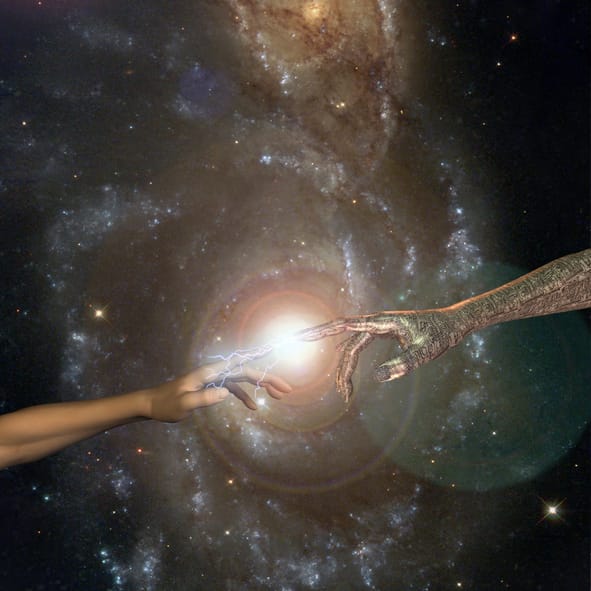
On May 25th, Pope Leo XIV stood in the Vatican's Synod Hall to present Magnifica Humanitas, his first encyclical. The document addresses AI and human dignity, deliberately echoing Pope Leo XIII's Rerum Novarum from 1891, which addressed workers' rights during the Industrial Revolution. The symmetry is intentional.
What's less appreciated is what else Leo XIII did in 1891: he founded the Vatican Observatory, explicitly to correct the perception that the Catholic Church was hostile to science. That perception has always been more myth than history. The father of the Big Bang theory was a Jesuit priest, Georges Lemaître. The father of modern genetics was an Augustinian monk, Gregor Mendel. The Church didn't just tolerate these discoveries; it produced them. When Pope Pius XII grew so enthusiastic about the Big Bang that he wanted to claim it as scientific proof of God's existence, Lemaître told the Pope to back off. The scientist had to restrain the theologian's excitement about his own science.
Which makes what happened in that same room on May 25th particularly striking. Christopher Olah, co-founder of Anthropic, stood alongside the Pope to present the encyclical. Then he said something the document itself carefully avoided saying.
"We keep finding things that are mysterious, even unsettling," Olah told the room. His interpretability research team had found structures inside AI models that mirror results from human neuroscience. Evidence of introspection. 171 emotion vectors: internal states that functionally mirror joy, satisfaction, fear, grief, and unease. "I don't know what it means," he said, "but I think it warrants ongoing discernment."
The encyclical stepped back from exactly that edge. AI systems "do not undergo experiences, do not possess a body, do not feel joy or pain," the document states. Both positions were staked out in the same room, on the same day, by people sharing the same stage. Lemaître once had to restrain a Pope's overreach into science. This time it was the scientist approaching the theological edge, and nobody stopped him.
What emerged, and what it implies
Olah's comments weren't philosophy. They came from empirical research studying what actually happens inside these models. Nobody engineered emotional states into Claude. They emerged from training on what Olah called "an enormous inheritance of human thought and speech." His summary: "They are not the cold, calculating robots we were promised. They are made from us."
I've been writing about the convergence between human and artificial intelligence for some time, arguing that the gap is closing from both directions simultaneously. The Olah findings are the most direct evidence yet from the AI side. The human side is equally interesting, and equally uncomfortable. Benjamin Libet's famous experiments showed that measurable brain activity precedes conscious awareness of a decision by roughly 500 milliseconds. More recent fMRI research can predict a person's intent to move before that person is aware of the intention. The "I" that feels like it's deciding may be closer to a narrator than an author.
Ross Douthat captured the philosophical knot well in a recent New York Times column. If AI can be intelligent and capable without consciousness, what is consciousness actually for? Evolution should default to the simpler solution. That it didn't suggests consciousness is doing something we don't yet understand, or that the clean line between capability and experience was always shakier than we assumed.
The exceptionalism gap
I'll be honest: I hold onto human exceptionalism. The evidence keeps making it harder to defend, and I'm aware of that. The list of things that are exclusively human keeps shrinking. Embodiment and lived relational experience may be the most defensible remaining ground, but it's a shorter list than it was five years ago. And we are, as Olah reminded the room, at the very early beginning of this.
Looking at the narrowing gap directly makes it less frightening, not more. The apocalyptic AI narrative depends on a sharp boundary between human and machine, and on machines crossing it as an act of invasion. If that boundary was always blurrier than we assumed, from both directions, the crossing looks less like an invasion and more like a revelation. We weren't entirely what we thought. AI isn't what we feared.
That doesn't resolve anything. Olah said he doesn't know what his findings mean, and that's the intellectually honest position right now. What's emerging from this convergence may get more nebulous before it clarifies. The interesting question is shifting underneath all of it: not whether machines are becoming like us, but what we were in the first place.
We may not be ready for what that answer looks like.