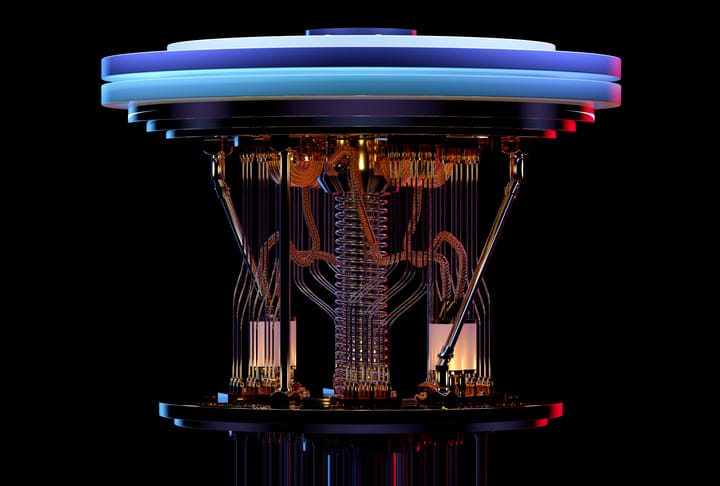
Last month, several stocks in my quantum computing portfolio suddenly jumped between 12% and 39% over just two days. The reason: the Commerce Department announced $2 billion in CHIPS Act grants to nine quantum computing companies, taking equity stakes in each. IBM received the largest share — roughly $1 billion, matched by a new IBM quantum venture called Anderon. D-Wave, Rigetti, Quantinuum, and Infleqtion each received approximately $100 million. The federal government, in other words, just placed a large, very public bet on quantum computing as a national security priority.
I've been building this portfolio for a couple of years, using AI to help develop investment criteria and monitor holdings across several specialized sector portfolios. I wrote about that approach here, and discussed the Space Tech portfolio in light of the upcoming SpaceX IPO last Friday. The quantum portfolio has always been the most speculative — the one where the commercialization timeline was hardest to pin down. Last month's announcement didn't change the science, but it changed the signal.
And the science has been moving faster than almost anyone expected.
A fundamentally different kind of machine
To understand why quantum computing is qualitatively different from anything we've seen before, it helps to start with what it isn't. Classical computers, including the ones running every AI model in existence today, operate on bits: binary values of 0 or 1. Every calculation, no matter how sophisticated, is a sequence of binary decisions processed sequentially. AI is genuinely impressive at pattern recognition and prediction, but it's doing that work on fundamentally classical hardware.
Quantum computers use qubits. Through a property called superposition, a qubit can exist in states of 0, 1, or any combination of both simultaneously — not one after the other, but at the same time. Through entanglement, qubits become correlated such that the state of one instantly influences others. The practical result: a quantum system doesn't evaluate one pathway through a problem at a time. It explores a vast solution space in parallel, arriving at probabilistic intermediate states rather than hard binary answers at each step. For certain categories of problems, the computational difference isn't incremental. It's the gap between tractable and impossible.
Chemistry is precisely that category. Molecular behavior — how atoms bind, how drugs interact with proteins — is governed by quantum mechanical principles. Classical computers approximate this, and the approximations get harder as molecules grow. The number of possible electron configurations increases combinatorially with molecule size, meaning computational cost doesn't scale linearly. It explodes.
From laboratory to the drug pipeline
Which is why results published this week from a collaboration between Cleveland Clinic, IBM, and Japan's RIKEN research center are worth paying attention to. The team used a hybrid quantum-classical framework to simulate two protein-ligand complexes at scales of up to 12,635 atoms — the largest biological molecule ever modeled with quantum computing assistance, using 94 qubits across two IBM processors combined with classical supercomputers.
The number matters less than the trajectory. Four months ago, the same team simulated a 303-atom miniprotein. This result is a 40-fold increase in system size and a 210-fold improvement in accuracy. In four months. The lead researcher, Dr. Kenneth Merz of Cleveland Clinic, said results like these are arriving years sooner than he would have predicted as recently as 2024.
This isn't one team's isolated result. Wellcome Leap, an initiative of London's Wellcome Trust, recently released outcomes from its $50 million Quantum for Bio challenge, where six independent research teams demonstrated quantum-classical hybrid approaches to biological problems. The top-rated project, awarded a $2 million prize, was led by Algorithmiq, a Finnish quantum software company working with the same Cleveland Clinic and IBM hardware. They simulated how an experimental photodynamic cancer drug is activated by light to destroy tumor cells, with results described by the company's CEO as "provably better than the corresponding classical method alone." Five of the six finalists worked with IBM hardware. This is convergence, not coincidence.
Drug discovery is the early commercial pathway for a reason. If you can accurately model how a drug molecule binds to a target protein before synthesizing it in a lab, you compress the most expensive phase of pharmaceutical development. AI is already accelerating parts of this (my recent post on the intelligence explosion touched on Anthropic's acquisition of Coefficient Bio and AI-designed cancer molecules reaching Phase III trials). Quantum adds a layer of molecular modeling fidelity that AI running on classical hardware fundamentally cannot match — because the underlying phenomena are quantum mechanical. IBM's CTO for quantum computing, Jerry Chow, expects large-scale practical application in chemistry and life sciences by the early 2030s.
The threat side of quantum is on the same hardware timeline. I covered quantum's risk to blockchain security last January; since then a Coinbase-convened panel of cryptographers published a position paper concluding that a quantum computer capable of breaking blockchain encryption will be built, and the window to prepare is narrowing. Quantum as tool and quantum as threat are the same technology, driven by the same underlying progress, arriving on the same schedule.
May's government investment reflects exactly this dual reality. The $2 billion isn't positioned as science funding, it's framed as a national security move, explicitly aimed at maintaining an advantage over China in advanced computing. That framing matters. It means this isn't a research grant program that might get cut in the next budget cycle. It's strategic infrastructure investment.
We spent years being warned that AI was coming and still managed to be surprised by how fast it arrived and how broadly it applied. Quantum is on a similar arc, with a somewhat longer runway. The difference is we're watching it develop in real time — enzyme simulations scaling 40-fold in four months, cancer drug modeling, virus genome encoding, and now $2 billion in federal backing landing in a single day. These aren't conference demonstrations or speculative roadmaps.
Are we ready this time?