By Norman Bodek
This article is from the Superfactory Archives, an archive of content from the Superfactory website that existed from 1997 to 2012.
This past April, I led an Institute for Lean Systems study mission to Japan. In the past, when I owned Productivity Inc. Press, I lead probably 30 similar study missions to Japan, all great, but none had been better then this one. In setting up these trips, I am never sure exactly what will be seen or learned from the experience. I work very hard to locate exceptional companies to visit and go over to Japan with a lot of hope that everything will prove to be beneficial to the travelers. But, I am never sure of the learning experience. Miraculously, this trip went much further then expectations and our group returned home filled with new exuberances, new content, and a new depth of knowledge to help companies outside of Japan to improve their manufacturing processes. In a “nutshell,” on this trip we discovered:
That it is possible to “Leap Frog Toyota.”
At the recent Shingo Prize conference, I asked around 500 attendees, “How many of your companies are attempting to be Lean?” Almost all hands went up. Then I asked, “How many of your companies are Lean?” Not one hand was raised. Not one. What is Toyota doing that other companies are not doing? And is it possible to catch them? Even better, is it possible to “Leap Frog Toyota?” I didn’t think so until I went to Japan and visited both Toyota and Canon.
Toyota is probably the most successful manufacturer in the world. They do many amazing things to be so productive. Recently, their chairman, Mr. Watanabe stated that Toyota will again cut their costs tremendously.
"We've started what we call "emergency value analysis activities." We've formed teams to review every single part and component over the next six months to determine how to improve designs to reduce production costs further. Some employees still lack awareness of these activities, but we plan to work on developing our human resources in tandem with this effort."
Before visiting Toyota’s Tahara plant, I read Jeffrey Liker’s and Michael Hoseus’s new book “Toyota Culture: The Heart and Soul of the Toyota Way.” An excellent read, one that excites you as to the possibilities of how to develop people to their fullest potential. As I read the book, I thought the true difference between Toyota and others was their investment in their people. In fact, Toyota calls it “Respect for People.” Then I discovered from my visit to Japan that there is a vast gap between the theoretical and the actual. Yes, Toyota does continually develop people but “takt” time, a key to Toyota’s success, also gets in the way from fully giving people opportunities to live fulfilled lives at work.
While “takt” time allows Toyota to balance their production facilities, it also gives people very limiting work lives and what I observed it is far from “Respect for People.”
As our group walked along the assembly line at Toyota, it was hard not to be impressed with their production system. It is lean and efficient and surely far beyond the other automobile companies. I had, however, never really thought deeply enough about the quality of work life for the average worker on the line. I looked at the efficiency of the production process and the beauty of the automobiles but hardly ever considered what work was it like for the average production worker. Until, I stopped and watched one young man on the assembly line installing in one minute, the takt time, around eight to ten bolts into each car. The job looked quite tedious as he had to reach overhead to install the bolts in one minute into each car and also onto 500 cars that same day, and I was told he would continue to do this job for the next three months. How could I reconcile the facts in Liker’s and Hoseus’s book about investing in each worker’s development and seeing this young man doing this tedious, repetitious and obviously boring job?
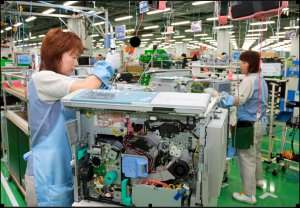
I did not think that much about this until two days later when I went to a Canon plant and was told that the worker I saw building a copier was under a 30-minute “takt” time. Now just think with me. This Canon worker could assemble the entire copier without any assistance from another worker. In fact, in this plant there are eight people, called “super meisters,” that can build an entire large copier with a four-hour takt time. They know how to assemble over 3000 parts at the highest levels of quality and productivity. To me this is a real revolution in designing work for intelligent human beings. It recognizes that people have enormous talents, if trained properly, respected deeply, and challenged by management to reach their highest levels of self-actualization.
Ironically, Canon 10 years ago did have a conveyor belt system in their final assembly area, similar to Toyota, but learning from Toyota consultant’s they switched to a cellular manufacturing system. But, unlike Toyota that has workers with very short “takt” times doing very repetitive work, Canon has developed and trained their workers to expand their capabilities exponentially.
In the 1800’s, there were master craftspeople responsible for building the entire product for the customer; carpenters for example would make an entire table from start to finish. Young people would apprentice for maybe six years with a master carpenter learning the entire skills necessary to become a master on their own. Then in the early 1900’s Frederick Taylor and Henry Ford changed all of that by setting up an assembly line, simplifying work with the division of labor. Jobs became repetitive and boring. Since many people in America were immigrants, could hardly speak English, Ford gave them an opportunity to make a living for their family. This system brought vast wealth to America but at the same time created tedious and boring work.
Well the times have changed. We are in the 21st Century. People are more educated and work should accordingly change to current skill sets and knowledge of the American worker.
Whenever I teach, I ask the audience, “What is your favorite day of the week?” Almost everyone answers, “Friday.” They love Friday because the next day is Saturday. They do not love and nor do they look forward to their jobs.
A week ago, I had a phone conversation with Alan Robinson, professor of management at the University of Massachusetts and the author of “Ideas are Free;” he told me that from a recent survey of his students 60% stated that “they hate their jobs.” Imagine going to college for four years and ending up, at work, hating what you do.
Well, Canon is bringing us a new possibility. Canon is willing to not only make great products but also is willing to invest in their people so that they can attain real dignity from their work. In one sense, it does not matter what you do long as you have an opportunity to “learn and grow,” every day on the job.
But, Toyota, Canon and many of the other Japanese companies do give people the opportunity to learn and grow from their own ideas. From a recent copy of the New Yorker magazine:
“The answer has a lot to do with another distinctive element of Toyota’s approach: defining innovation as an incremental process, in which the goal is not to make huge, sudden leaps but, rather, to make things better on a daily basis. (The principle is often known by its Japanese name, kaizen—continuous improvement.) Instead of trying to throw long touchdown passes, as it were, Toyota moves down the field by means of short and steady gains. And so it rejects the idea that innovation is the province of an elect few; instead, it’s taken to be an everyday task for which everyone is responsible. … Toyota implements a million new ideas a year, and most of them come from ordinary workers. (Japanese companies get a hundred times as many suggestions from their workers as U.S. companies do.) Most of these ideas are small—making parts on a shelf easier to reach, say—and not all of them work. But cumulatively, every day, Toyota knows a little more, and does things a little better, than it did the day before.” by James Surowiecki May 12, 2008, the New Yorker Magazine
I think Canon is ahead of Toyota in terms of developing their people but I am sure that Toyota will catch up quickly. The question is “will you?”