Discovering the Lean Supply Chain: Transforming Suppliers into Powerful Lean Differentiators
By Robert Hawkey
This article is from the Superfactory Archives, an archive of content from the Superfactory website that existed from 1997 to 2012.
Introduction
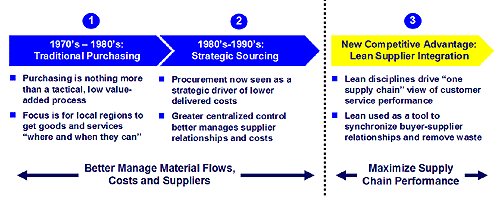
Mention the phrase “strategic sourcing” and a number of thoughts, concepts and disciplines come to mind including supplier selection strategies, supplier performance improvement, purchased price reductions and streamlined buyer-supplier transactions management. While each of the preceding tactics can play an important role in supply chain optimization, they all fail to capture one of the single biggest advantages supply chain operations confer on any manufacturer by providing a tailor-made vehicle for driving Lean outside of the organization’s four walls and upstream into the supplier community. By using supply chain management as a driver of enterprise-wide Lean transformation, savvy manufacturers can successfully capitalize on the next strategic phase of supplier management and dramatically enhance the use of Lean as a true competitive weapon:
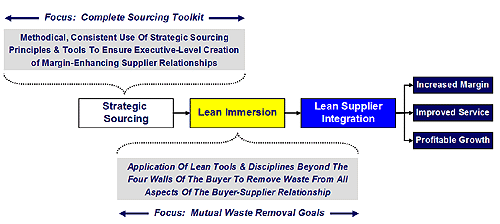
Without question, Lean disciplines, methodologies and practices have all yielded significant benefits to manufacturers willing to systematically drive out waste and transform their organizations into highly flexible, low-cost machines dedicated to providing leading-edge customer service performance. Despite these “in the four walls” successes, the true benefits of Lean can never be realized (along with the maximization of customer service performance) until Lean disciplines are exported across the global supply chain into the supplier community. Simply put, unless manufacturers place the same emphasis driving Lean disciplines across the extended enterprise as they do within their own four walls, the complete transformative effects of Lean will never be realized. To that end, Lean creates a seamless integration of proven strategic sourcing capabilities such as fact-based negotiations and cross-functional sourcing teams with core Lean tools such as Value Stream Map enhancement through waste removal:
Lower total delivered cost, supplier rationalization, compressed order-to-delivery lead times and global capacity planning are all realistic goals and necessary supply management tactics when trying to optimize the buyer-supplier relationship. Rather than focusing on individual tactics, smart manufactures would do well to build a Lean supply chain capability designed to create total supply chain transparency and use Lean as a differentiator when selecting and integrating members of their supplier community. In order to achieve success, manufacturers must be willing to adopt three key features associated with Lean supply base management concepts:
-
Shift your focus away from purchase price to Value Stream Map (VSM) integration and global capacity management,
-
Transform the RFP process into an information-sharing exercise where Lean concepts drive supplier selection and integration, and
-
Build, deploy and promote supplier “university” educational platforms where Lean best practices and joint waste removal opportunities are not only exploited, but are contractually mandated
The adoption of Lean is never a short or simple journey, and the decision to move beyond the four walls of your own operation should never be taken lightly. However, if Lean is providing the flexibility and waste-free culture it was designed to produce within your business, moving Lean upstream to your supplier community is your next logical step.
Value Stream Mapping Revisited: The Priority of Integration Over Low Prices
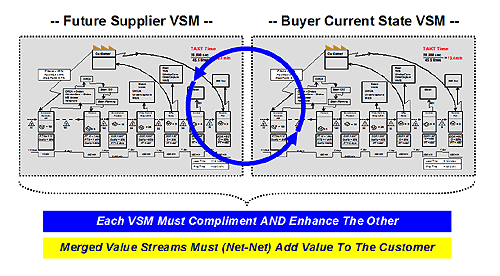
Far too often, strategic sourcing efforts are undertaken to lower the purchase price of the goods or materials in question without regard for the ultimate impact on total supply chain performance and, ultimately, customer service. Key decisions such as low-cost country sourcing can produce significantly lower purchase costs while creating havoc in terms of decreased flexibility, expanded lead times and higher-cost operations through increased buffer stock investments. While lower costs are a natural component of any sourcing operation, lower costs, as an overriding objective, will obscure the ultimate goal of creating a synchronized supply chain where the supplier’s value stream map (how they create what is purchased) is wholly integrated with the buyer’s value stream map (how the purchased item is transformed into a customer deliverable) to form one seamless supply chain servicing the customer:
While cost management should remain a key component of the sourcing process, the shift to value stream analysis prevents imbedded waste from escaping detection and artificially inflating supply chain costs and diminishing service performance. Key buyer-supplier processes such as order management, inventory deployment, manufacturing processes, transportation and distribution operations must all be captured by the mutual value stream maps of both parties for obvious reasons:
-
“Hidden” waste within the supplier’s VSM will inflate the actual purchase cost.
-
Institutionalized waste within the buyer’s operation can cast significant doubt on the buyer’s Lean commitment (more on that in the next section).
-
Waste on both sides reduces global supply chain flexibility and will eventually result in a sub-optimal customer service solution.
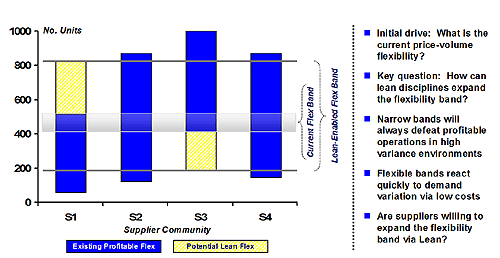
Reduced supply chain flexibility, as described in the third observation above, is perhaps the single most overlooked advantage that can be captured in the Lean sourcing process. As is often the case, the potential supplier pool may offer the requisite parts, components or materials required by the buyer, but at a negative delivered cost or flexibility impact. Through joint buyer-supplier VSM ownership and improvement efforts, savvy manufacturers can build global Lean supplier improvement programs by isolating VSM-based waste thereby expanding the availability of low-cost supplier capacity. Buy pushing waste eliminate strategies upstream through such proven concepts as demand-driven operations planning, kanban materials flow and level-pull scheduling techniques, Lean manufacturers can create new “flexibility bands” within their supplier communities where Lean disciplines drive improved capacity utilization and allocation based on true end-customer demand:
The ultimate question remains: Is the goal of your strategic sourcing efforts designed to secure new suppliers who provide a lower purchase price, or are your efforts driving the selection and integration of suppliers who will drive quantifiable improvements in supply chain flexibility and service performance? Only the buyer-supplier value stream map can tell.
The RFP: Your Personalized Lean Go-To-Market Messsaging Platform
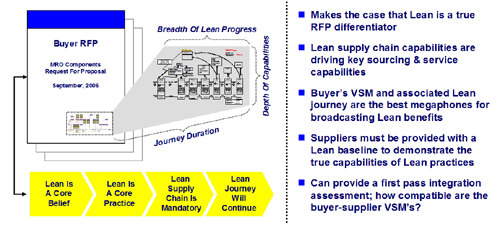
RFP’s are highly useful tools to evaluate potential suppliers, test the availability of required parts or materials, and convey the buyer’s key business and engineering requirements. For those buyers willing to aggressively migrate Lean thinking upstream, RFP’s become highly focused tools espousing the buyer’s Lean commitment and their desire to align themselves with like-minded suppliers. Far beyond mere communication vehicles outlining mundane specifications or delivery requirements, Lean-oriented RFP’s actively showcase the buyer’s Lean journey and the rationale for utilizing Lean as a marketplace differentiator:
While knowledge of Lean as a theory may be scattered across the potential supplier community, the buyer has a powerful opportunity to clearly articulate their personal Lean journey including the adoption of Lean as an operating platform, the transformative effects Lean generates through waste removal and the complete benefits snapshot Lean has conferred upon the buyer. If the spotlight on Lean appears bright, consider the open questions across the supplier community that the buyer might be faced with should the RFP lack a strong Lean emphasis:
-
Is Waste removal subordinate to simply obtaining a lower purchase price?
-
Is Lean even a priority with the buyer? Is Lean even a core supplier requirement?
-
Is Lean a factor in the eventual RFP scoring and supplier selection process?
When the environment is created where these questions are even a remote possibility, buyers will have missed their first, best opportunity to differentiate themselves to the supplier community in terms of their Lean commitment and how Lean tools and disciplines will be contractually deployed to the buyer-supplier relationship in order to reduce total delivered costs year-over-year. By crafting a detailed, Lean journey-based RFP, suppliers can immediately dispel the notion that the go-to-market strategy is based around capturing the lowest purchase price; instead, buyers can demonstrate how joint ownership of the merged buyer-supplier VSM can produce a relationship where year-over-year waste reductions through joint Lean events can produce a superior supply chain model. In addition, buyers can also provide the compelling argument necessary for suppliers to understand how their participation in the extended supply chain will reinforce the buyer’s Lean vision and enhance (or even accelerate) the combined Lean Journey:
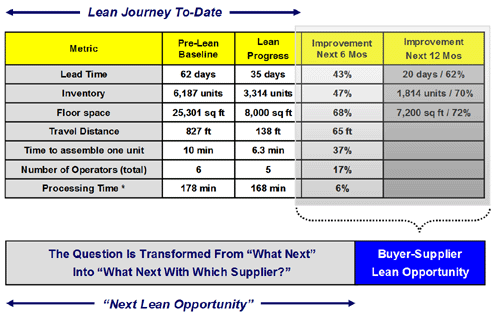
By carefully articulating the buyers’ overall Lean program, pre-Lean environment, Lean waste reduction achievements and future Lean goals, aggressive suppliers who embrace even the most basic Lean disciplines will clearly identify their “fit” in the existing supply chain and how their presence will further optimize extended supply chain operations and add incremental value to the end customer. In so doing, Buyers can create exciting new opportunities to on-board new suppliers or enhance existing relationships through the Lean RFP process:
-
Selecting new suppliers that can bring new Lean tools and capabilities to the buyer;
-
Identifying new supply sources where the combined Lean experiences can radically transform existing supply chain capabilities, or,
-
Provide a window for existing suppliers to adopt buyer-based exported Lean disciplines and practices and create a completely new value proposition for the buyer (and, further downstream, for the end customer).
While the first two clearly point to the selection and integration of new suppliers, the third comment highlights a very subtle opportunity many buyers have. Through the RFP process, which creates a highly visible level playing field for all participating suppliers (and therefore eliminates the corrosive environment that often results from incumbent supplier preferences), buyers can offer incumbent suppliers a new engagement model where the supplier can develop and offer a new value proposition based on the adoption of Lean practices. To that end, incumbent suppliers who might otherwise face replacement because of their diminishing value-added capabilities, can embrace the RFP process to challenge themselves and develop new offerings that can maximize the total value delivered to the end customer.
After The RFP, Then What? Using Supplier Universities to Maximize Waste Reductions
Far too often, methodical supplier identification, selection and integration efforts produce a very successful “first year” relationship where lower purchase prices and new supplier capabilities combine to produce a compelling value proposition for the end customer. Tragically, buyers and suppliers frequently allow the relationship to lapse into a year-over-year “repeat” of the first-year gains where continuous improvement and an ever-increasing end-customer value proposition become footnotes on the invoice. If the benefits of outside-the-four-walls Lean are to be truly captured, buyers must take the lead in developing and implementing programs designed to maximize, for each year of the contractual relationship, the value offered to the customer through the systematic elimination of waste across the supply chain.
Discussed above, the originating RFP provides the necessary signal to the supplier community regarding the buyer’s commitment to Lean and how Lean disciplines will function as an integral component of the buyer-supplier relationship. Once the relationship is consummated and the supplier becomes integrated into the extended supply chain, the relationship must then be subjected to a robust process that mandates year-over-year waste reductions within the merged buyer-supplier VSM. In many cases, the relationship is considered complete once the transactional processes are in place and the buyer successfully receives the first shipment of materials or components that meet the contractual specifications. In the Lean supply chain, the initial integration process is nothing more than the first step to a developing relationship where the buyer and supplier assume joint contractual responsibility for eliminating waste each year under the contract:
-
During the RFP process, buyer-initiated on-site supplier Lean assessments will generally uncover waste reduction opportunities that, once accomplished, will provide lower future delivered costs.
-
Like all Lean improvements, buyer-supplier VSM enhancements are part of a consistent journey and must be investigated and captured at the appropriate time in the journey.
-
By institutionalizing a common vehicle for performance management, waste identification and waste removal, buyers create an environment where they can be considered the “buyer of choice” when suppliers determine where to allocate their limited capacity.
Especially for those suppliers who are new to lean and just beginning their journey, highly experienced Lean buyers have an obligation to such suppliers to clearly articulate Lean strategies and provide access to proven in-house Lean tools in order to maximize the value new suppliers can provide early in the relationship. As a vehicle for institutionalizing Lean principles across the supply chain and ruthlessly attacking waste, supplier universities are quickly gaining the recognition they deserve as a key component of any Lean strategy.
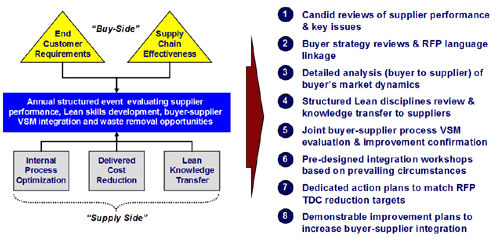
Articulated in the originating RFP, supplier universities are structured programs designed to closely monitor the buyer-supplier relationship against contractual delivered-cost reductions to ensure that buyers and suppliers jointly assume responsibility for eliminating waste to continually enhance the customer value proposition. Far more than a simple knowledge transfer process, supplier universities provide customized Lean journey programs for each supplier and develop detailed supply chain Lean best practices for dissemination to all suppliers during annual or semi-annual buyer-supplier VSM improvement events:
Based on the conceptual model above, it should be readily apparent that a supplier university (or, a supplier integration university denoting the fact that Lean improvements never cease) should be comprised of four fundamental capabilities:
-
The university model should require the buyer to consolidate their Lean capabilities, tools and practices and build a buyer-specific Lean best practices guidebook
-
Contractual obligations of the buyer and supplier should be codified and transformed into a published joint event schedule to enact contractual total delivered cost reductions through continual waste elimination
-
Annual or semi-annual events should focus on achieved benefits, known shortfalls, and place equal emphasis on the buyer’s and supplier’s role in continually augmenting the end-customer value proposition
-
The buyer has the primary responsibility for disseminating Lean best practices across the supplier community to further reinforce the dedication to Lean practices
Considered a mandatory event for suppliers (again, clearly articulated in the RFP), supplier university annual or semi-annual events provide a powerful, highly visible platform for suppliers to showcase their own internal Lean successes, waste removal efforts, and joint improvement programs with downstream suppliers. Such improvements can then be balanced against the contractual requirements to determine if the buyer and supplier have met their respective obligations to enhance the existing VSM. In the end, the originating RFP, backed by the contractual responsibilities of both parties, combine to create “first year” results for every year of the relationship.
Summary: How Strong Is Your Sourcing Filter?
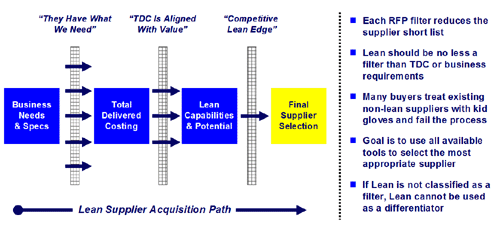
Lean, if properly used to drive supply chain performance beyond the four walls of the buyer, becomes a powerful filter through which a level playing field is created providing the most accurate method for identifying, selecting and integrating those suppliers capable of the highest value proposition to end customers:
By inserting the Lean filter into the strategic sourcing process, savvy buyers have a unique opportunity to create and field unique market offerings for end customers based on the highest match of supplier capabilities to business requirements, the lowest possible total delivered cost model, and the power of continual waste reductions triggered by Lean disciplines and practices. Is your sourcing filter ready?