Fordlandia: How Henry Ford Forgot His Own First Principle
If you've spent any time in the lean world, Henry Ford is essentially a founding father. The moving assembly line. Continuous flow. Waste elimination as a design principle, not an afterthought. Taiichi Ohno and Shigeo Shingo studied Ford obsessively; the Toyota Production System is, in many ways, Ford's system extended and systematized. We owe him a lot.
Which is exactly what makes Fordlandia so uncomfortable to talk about.
In 1927, Ford purchased a tract of land in the Brazilian Amazon roughly the size of Connecticut. The goal was sensible enough: the British rubber cartel controlled global latex prices, and Ford needed rubber for tires. Vertical integration was his religion, so why not grow your own? He'd just overseen the completion of River Rouge, arguably the greatest manufacturing complex in history, with raw ore going in one end and finished automobiles rolling out the other. How hard could a rubber plantation be?
Very hard. And the failure traces directly back to the one principle that made River Rouge brilliant in the first place.
Watching the Work
Ford's early genius, from the Piquette Avenue plant through Highland Park, was rooted in direct observation. He encouraged constant floor-level experimentation, the kind that can only happen when people in charge are physically present where the work happens, watching material flow, watching people move, watching friction accumulate. It was this empirical, eyes-on instinct that produced the moving assembly line in 1913, the five-dollar day in 1914, and ultimately the logic that underpinned everything at River Rouge.
River Rouge itself was largely built on that same principle, even if Ford had stepped back from the floor personally by then. Charles Sorensen, known around Ford as "Cast Iron Charlie," was the operational architect of the Rouge. According to Sorensen's own memoir, My Forty Years with Ford, it was Sorensen and his team doing the hands-on experimentation that actually drove the assembly innovations, with Ford encouraging the culture even as Sorensen executed it. Sorensen had conceived key elements of the moving assembly line at Highland Park, then took charge of River Rouge production and ran it with the same floor-level intensity. The Rouge worked because the people responsible for it were embedded in its reality daily.
Decades later, Taiichi Ohno would formalize this instinct into a named practice, the gemba walk, from the Japanese word for "actual place." Ohno made it a foundational discipline of the Toyota Production System: go to where the work happens, observe directly, don't manage from abstractions. But the underlying idea, that you cannot understand a process without watching it, was Ford's first.
He just forgot it when he went to Brazil.
The Amazon Plan
Ford negotiated a concession of roughly 10,000 square kilometers on the banks of the Rio Tapajós, deep in Pará state, in exchange for a 9% share of any profits. He sent American managers with no Portuguese, no botanical expertise, and no tropical agriculture knowledge. He imposed American day shifts on Brazilian and indigenous workers who, entirely rationally, preferred to work nights to avoid equatorial heat. He built Cape Cod-style houses, a golf course, movie theaters, and a cafeteria serving brown bread, canned peaches, and oatmeal in a rainforest. Not one drop of latex from Fordlandia ever made it into a Ford car.
And Ford himself? In spite of the enormous investment and numerous invitations, he never visited either of his ill-fated towns. Not once.
The man whose manufacturing philosophy demanded presence, observation, and direct engagement with process sent managers who had none of those things, into a system they'd never observed, and apparently never insisted otherwise.
The Blight Nobody Saw Coming (Except Everyone)
The agricultural failure is the most viscerally ironic part of the story. Hevea brasiliensis, the rubber tree, grows naturally dispersed across the Amazon because dispersal is its primary defense against Microcyclus ulei, a leaf blight pathogen that had co-evolved with the tree for millennia. The trees are scattered precisely because clustering them is fatal. This was not obscure botany in 1927; it was documented. Ford was famously reluctant to hire native naturalists who could have advised him on growing rubber in the region.
Instead, his managers planted the trees in dense American crop-grid rows, the way you'd grow corn in Iowa. The trees were easy prey for blight, Saúva ants, lace bugs, red spiders, and leaf caterpillars. The plantation didn't fail despite Ford's approach; it failed because of it. His team solved for the wrong problem, with the wrong model, without observing the actual system they were working in.
At Highland Park, Ford's people solved problems by watching work directly. At Fordlandia, they imposed a mental model of how things should work and waited for nature to comply. Nature declined.
The Cafeteria Riots Were Predictable
The human dimension was no subtler. Brazilian laborers accustomed to their own diet, rhythms, and culture were handed American cafeteria food and mandatory square dancing. As historian Greg Grandin documents in his definitive account Fordlandia, Ford had very particular ideas about proper diet, and his managers dutifully imposed them: brown rice, whole-wheat bread, canned peaches, oatmeal. Workers rioted in 1930, overturning the food lines and wrecking the cafeteria equipment. Predictable. Preventable. Never anticipated.
Had anyone been watching the work, meaning the actual human work of building a functioning community in a foreign culture, the friction would have been obvious long before it boiled over. Nobody was watching. There was no Sorensen equivalent in the Amazon, and Ford didn't seem to notice the gap.
Why This Happens
Daniel Kahneman's concept of the "inside view" is useful here. The inside view means reasoning from your own experience and mental models. The outside view means looking at base rates, consulting domain expertise, and asking what actually tends to happen in situations like this one. Ford's early manufacturing genius was built on a ruthless outside view: go observe what's actually happening, not what you think is happening.
In the Amazon, he switched entirely to the inside view. He knew how to build things. He knew what a good diet looked like. He knew how a well-run operation should function. The fact that rubber trees, tropical ecology, and Brazilian laborers didn't behave like Michigan steel workers was apparently beside the point.
This is the trap that waits for anyone who gets genuinely good at something. Mastery builds confidence, and confidence tends to generalize well beyond the domain that earned it. The habits that made Ford a brilliant manufacturer, decisive, impatient with friction, trusting his pattern recognition, became liabilities when the patterns didn't apply. He didn't fail lean. He failed to recognize where his instincts were domain-specific and where they were just hubris wearing the costume of experience.
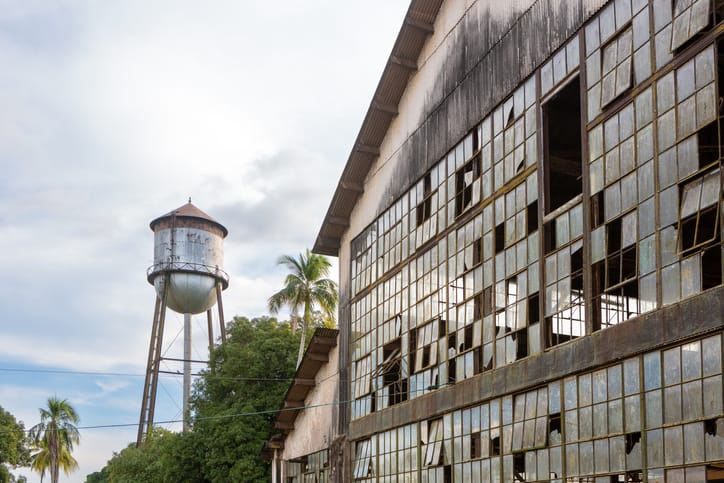
In 1945, Ford's grandson Henry Ford II sold the land back to the Brazilian government for a loss of over $20 million, equivalent to more than $350 million today. The jungle reclaimed most of it. Vines grow over the Cape Cod bungalows. A rusting water tower still bears the Ford logo, faded but legible.
Ohno would later give a name to the principle Ford built his empire on, then abandoned in Brazil. The question for the rest of us is simpler: where are you managing from a comfortable distance, trusting a mental model you've never actually tested against the work?