Kuku Sabzi - Iran's Herb-Packed Frittata of Renewal
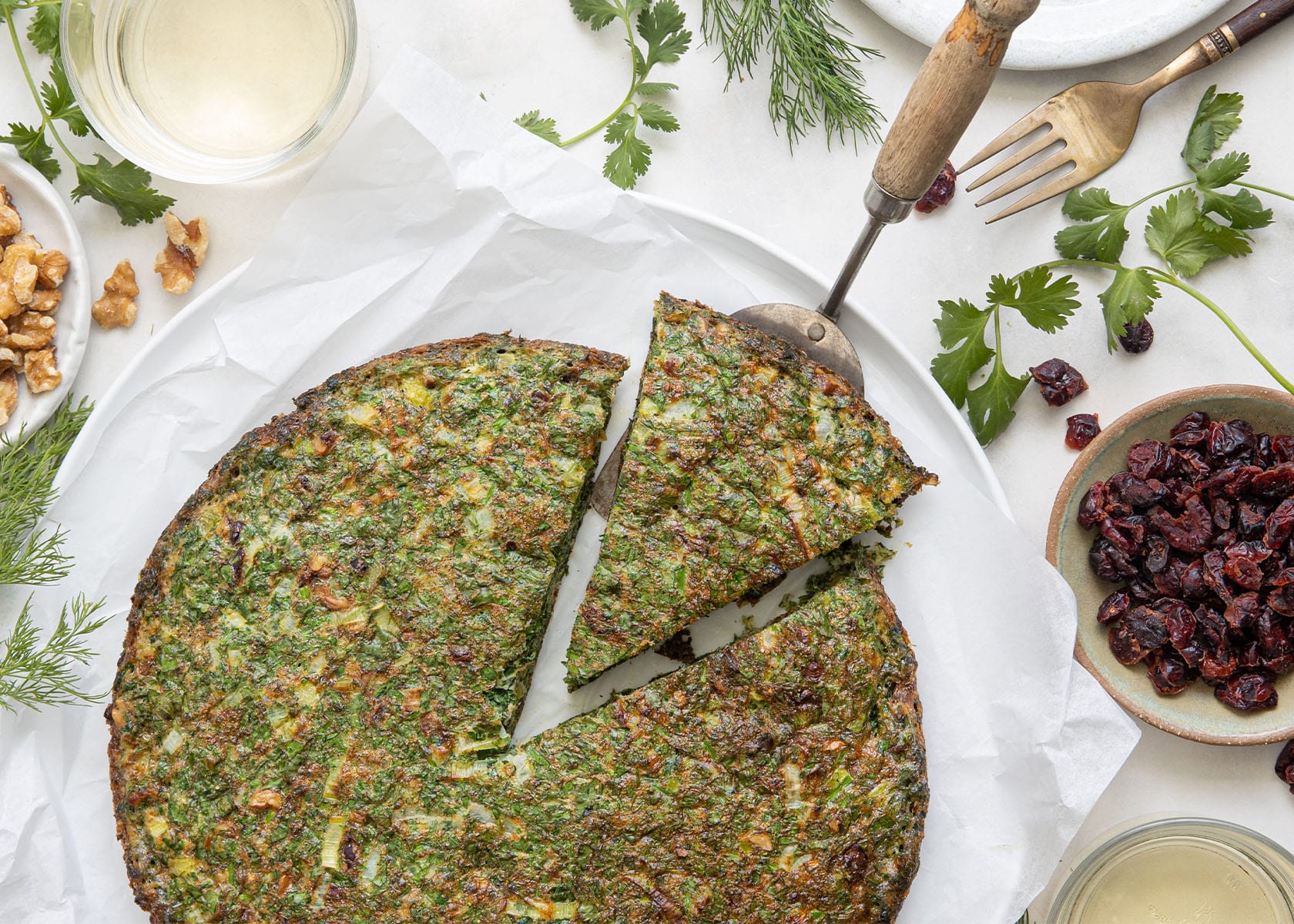
Serves: 2
Total time: ~35 minutes
Difficulty: Easy
Diet: Vegetarian
Social & Historical Context
Kuku Sabzi is one of the most quietly distinctive dishes in Persian cuisine — a dense, herb-packed frittata that inverts the usual egg-to-filling ratio so completely that the eggs function more as a binder than a base. Where a Western frittata might contain a handful of herbs as garnish, Kuku Sabzi is built from herbs with just enough egg to hold them together. The result is a cake-like round that is intensely green, faintly bitter, and unlike anything else in the international repertoire of egg dishes.
The dish is inseparable from Nowruz, the Persian New Year celebrated at the spring equinox — one of the oldest continuously observed holidays in human history, predating Islam by several millennia. At the Nowruz table (haft-sin), green foods symbolize renewal and the return of spring, and Kuku Sabzi is almost always present. Families prepare it in large rounds the day before, slicing it cold the next morning alongside pickles, yogurt, and flatbread. It is simultaneously a celebratory dish and an everyday one — made quickly on weeknights, sliced into a packed lunch, or served at room temperature as part of a larger spread. That versatility is part of its appeal.
Persian cuisine more broadly reflects a culinary tradition stretching back to the Achaemenid Empire, one of the ancient world's most sophisticated civilizations. The balance of bitter, sour, and herbal flavors that defines Kuku Sabzi — fenugreek for bitterness, a touch of barberries or lemon for acidity, dill and cilantro for brightness — is a microcosm of Persian cooking's core philosophy: not heat or spice dominance, but layered, harmonious contrast. For two people eating together, Kuku Sabzi rewards the kind of unhurried attention it rarely gets at a large table — you'll notice exactly how the fenugreek shifts the flavor, how the crust differs from the center, and how well it pairs with cold yogurt and warm bread.
INGREDIENTS
Kuku Sabzi
- 4 large eggs
- 1½ cups fresh flat-leaf parsley, finely chopped (packed)
- 1½ cups fresh cilantro, finely chopped (packed)
- ½ cup fresh dill, finely chopped
- 3 scallions, thinly sliced (green and white parts)
- 1 tsp dried fenugreek leaves (shanbalileh — see note below)
- 2 tbsp dried barberries (zereshk), picked over (or substitute 1 tbsp currants + ½ tsp lemon zest)
- 2 tbsp raw walnuts, roughly chopped
- ½ tsp baking powder (gives slight lift and a lighter interior)
- ½ tsp kosher salt
- ¼ tsp black pepper
- ¼ tsp turmeric
- 1½ tbsp neutral oil or clarified butter
Fenugreek note: Dried fenugreek leaves (kasuri methi at Indian grocery stores, or shanbalileh at Persian/Middle Eastern stores) are essential — they provide the characteristic slight bitterness that defines authentic Kuku Sabzi. Do not substitute fresh fenugreek or fenugreek seeds; the flavor is too aggressive. If unavailable, omit rather than substitute.
Barberry note: Dried barberries are small, tart red berries central to Persian cooking. They're available at Persian or Middle Eastern grocery stores and online. The currant-plus-lemon-zest substitution is a reasonable workaround but the flavor is less complex.
Accompaniments
Mast-o-Khiar (Persian Cucumber Yogurt)
- 1 cup full-fat Greek yogurt
- 1 Persian cucumber, finely diced
- 1 tbsp fresh mint, finely chopped (or ½ tsp dried)
- 1 tbsp fresh dill, finely chopped
- 1 small clove garlic, finely grated (optional)
- Salt to taste
- Pinch of dried rose petals (optional garnish)
To Serve
- Warm flatbread — lavash, barbari, or thin pita
- Extra fresh herbs for the table
RECIPES
Mast-o-Khiar (Make First)
- Combine yogurt, cucumber, mint, dill, and garlic (if using). Season with salt.
- Cover and refrigerate at least 20 minutes before serving. Flavor improves with time. Garnish with rose petals just before serving if using.
Kuku Sabzi
- Prep the herbs. Wash and dry all fresh herbs thoroughly — excess moisture will steam the kuku rather than set it. Chop finely. This is not a rough chop; the herbs should be fine enough that the mixture coheres when pressed.
- Mix the batter. Beat eggs in a bowl until smooth. Add salt, pepper, turmeric, and baking powder; whisk briefly. Add all chopped herbs, scallions, dried fenugreek, barberries, and walnuts. Fold everything together until fully combined. The mixture should look almost entirely green with egg barely visible — that ratio is correct.
- Cook the kuku. Heat oil or butter in a 8–9 inch non-stick or well-seasoned cast iron skillet over medium-low heat. Pour in the herb mixture and press gently into an even layer. Cover with a lid or foil and cook undisturbed for 10–12 minutes, until the edges are set and the center is mostly firm when gently pressed.
- Flip and finish. Slide the kuku onto a large plate, then invert it back into the pan to cook the second side uncovered for 4–5 minutes until the crust is deep golden-brown. Alternatively, finish under a low broiler for 3–4 minutes — this is easier and gives an even crust. The exterior should be distinctly darker than the interior.
- Rest before serving. Slide onto a cutting board and rest 5 minutes minimum before slicing. Kuku Sabzi is served warm or at room temperature — never piping hot. The flavor and texture both improve as it cools slightly.
COOKING ORDER
- Make mast-o-khiar → refrigerate (can be done up to 2 hours ahead)
- Wash and dry herbs thoroughly — allow time for this; wet herbs are the main pitfall
- Chop all herbs and prep remaining ingredients
- Warm flatbread (wrapped in foil in a low oven, or briefly on a dry pan)
- Mix and cook kuku
- Rest kuku → slice and serve
PRESENTATION & SERVING
- Slice the kuku into wedges like a cake, not squares. Four wedges for two people is the right portion.
- The cross-section should show a dense, uniformly green interior with a darker brown crust on both faces — that contrast is the visual signature of the dish. Arrange cut-side up so guests can see it.
- Serve mast-o-khiar in a small bowl alongside, not on top of the kuku.
- Warm flatbread torn into rough pieces on a plate or wooden board.
- A small pile of extra fresh herbs and a few whole walnuts on the plate add color and signal the ingredients without over-styling.
- Kuku Sabzi is excellent at room temperature, so there is no urgency at the table — it holds well for 20–30 minutes after slicing.
SHOPPING LIST
Produce
- 1 large bunch flat-leaf parsley
- 1 large bunch cilantro
- 1 bunch fresh dill
- 3 scallions
- 1 Persian cucumber
- Fresh mint (small bunch or packet)
- 1 head garlic
Dairy & Eggs
- 4 large eggs
- Full-fat Greek yogurt (1 cup)
Pantry
- Dried fenugreek leaves (shanbalileh / kasuri methi)
- Dried barberries (zereshk) (or currants + lemon)
- Raw walnut pieces (small bag)
- Neutral oil or clarified butter
- Baking powder
- Turmeric
- Kosher salt, black pepper
Bread
- Lavash, barbari, or thin pita
Optional
- Dried rose petals (garnish for yogurt)
- Extra lemon for the table