By Robert "Doc" Hall
This article is from the Superfactory Archives, an archive of content from the Superfactory website that existed from 1997 to 2012.
Plug Power is a company with big possibilities. Their website reveals this by having two major divisions of content, "Plug Is" and "Plug Will." The company began in 1997 mostly doing research on hydrogen fuel cells, and it still has the feel of a campus. But in 2001, the company began growing in size, aiming for a major role commercializing stationary power generation using hydrogen-powered fuel cells.
The company has competitors with the same ambition; three of them are Hydrogenics, Idatech, and ReliOn. However, because Plug Power started from a formidable research and technology base, it retains a strong technical staff. That's why many investors have bet on Plug Power as the most likely to pull off commercial breakthroughs. It is pointing toward becoming a major producer in one segment of the stationary electrical generator market: cell phone base stations. However, organizational growth preparing for this presented its own set of problems.
As more people came on board, the organization became too big to operate informally, and new people entering came from different prior work experiences. This resulted in a cultural amalgam. Plug needed systemic procedures, but traditional command-and-control could not achieve the collaboration necessary in a fastchanging technical environment. Besides a structure to hang it on, they needed a common culture - a common language and common behaviors that would enable people to come to agreement on tough decisions. Otherwise, a group of very talented people could not concentrate their potential on the stretch goals necessary to commercialize fuel cell generators.
No single grand project, managed by standard project management tools, could get them where they needed to go. They have a progression of objectives, one project building on another, and they must collaborate in technical exchange agreements with many outside parties. Collaborative learning had to persist indefinitely. It would last only if it became habitual, with internal systems developed to support the habit.
Gestation of a Distinctive Work Culture
Dr. Roger Saillant, a veteran Ford and Visteon executive, became the CEO in 2001. He began nudging people to develop a vision of what they wanted to be. A group of about 30 Plug Power employees calling themselves the Spark Plugs volunteered to develop a common way of working - a common culture. They began by reading some of the same books: Senge's Fifth Discipline, Cradle-to-Cradle , and Natural Capitalism. After all, the intrinsic motivation of most of them was to do something practical to promote environmental sustainability. But reading was not enough. The Spark Plugs went through a common course intended to make a "learning organization" real.
Probably the hardest part was the "soft stuff" to improve personal communication, so that people engaged in open dialog rather than talk past each other trying to win points. Some stock phrases to describe this behavior emerged. For example, talking about one's "Left Hand Column" means to open a discussion about something that is not necessarily agreed upon, and which may be emotional. A "Ladder of Inference" suggests a possible chain of causality without having all the cold facts. Likewise, "assessment" means "I think" or "I opine," when offering ideas not conclusively supported by data. Such phrases caution people to consider whether they have a factbased case before taking a hard-and-fast position. Such phrases, and the self-understanding they imply, avoid many personality clashes and much wasted time in meetings.
Behaving in this way is not as easy as may be thought at first. Learning how to have a dialog rather than win-lose exchanges takes practice. A Power Plug phrase that describes an individual's progress in this is "Personal Mastery."
Self-reflection and practice are necessary because people discover that they have not been conscious of their own habitual patterns of communication. For example, Dan Rodriquez, GenCore® program manager, said that when exasperated he had sometimes told people in meetings, "You're not listening to me." That set them on edge. An older engineer became his impromptu mentor, taking him aside to explain that he would be better received if instead he used a phrase like, "Let me explain this more clearly."
Like any other kind of process improvement, this aspect of cultural change entails many people making many small adjustments in how they interact over a long period of time. Dan Rodriquez and everyone else are continuing to improve their meeting finesse.
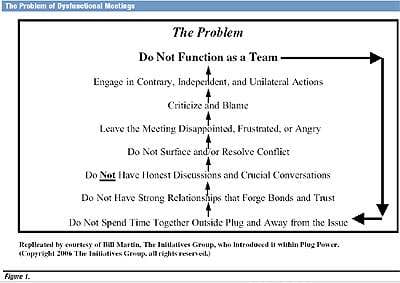
Rules for meetings, on being prepared etc., are insufficient. Meetings have to become interactive dialogs. How this becomes enmeshed in the work culture can be gleaned by studying Figure 1. Soon it became obvious that people at Plug Power had to know each other outside meeting rooms; they could not remain strangers and collaborate. Consequently, people are really expected to be committed to the company. It's not just a job. Anyone not inclined to be extraordinarily motivated probably will not be hired. Roger Saillant, the CEO, personally interviews everyone before they are hired. His main purpose is to assess whether this candidate is likely to become committed to the Plug Power working culture and fit in.
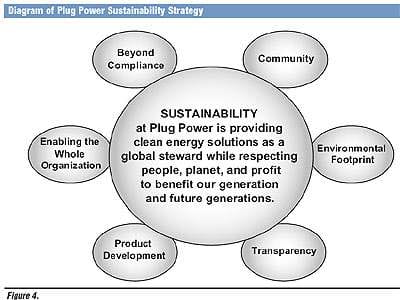
Besides addressing the soft side of developing a work culture, employees chewed on a values statement. Everyone at Plug Power who wanted to - most of them - had a hand in it. The result is the complex statement shown in Figure 2, but it is significant to Plug Power. Because so many people thought about it long and hard, and contributed to it, it represents their shared values. It's too long to memorize for recitation, but the eight key words around the circumference are printed on the back of everyone's identification badge, just as a reminder now and then. And because of the process from which it came, this values statement represents what Plug people will and won't do.
Process Improvement
While everybody worked on culture, Plug Power operations worked on developing lean processes. Current volumes are low, but the plant has cells, cross-trained people, 5S, a kanban system, visibility management, heijunka, etc. In a sense it is everybody's lean dream: starting up a greenfield operation lean from the get-go.
Of course, when volume is only one a day, product flow is not rapid. Not all the waste that might be evident at full volume can be seen, so Plug Power recently tested their preparation by building 11 units in one day. There were no major snags. They convinced themselves that when the time comes, the process will step up nicely. Goals for process improvement are mapped as measures on radar charts, so people can see the charts expand as they make progress.
In the meantime, operations resemble continuous 3P (Production Preparation Process). Both operations and product design have to be based on lean principles. Product design is always being improved by DFX (design for everything) - for manufacturability, for maintenance, for test, for field reliability, and of course, for cost. Operations must deal with a lot of changes, and operations are not confined to production. Given all the technical, environmental, customer, and supplier considerations in product and process development, it's obvious why Plug Power has to have a culture that fosters collaboration. For a common method of problem solving, they adopted 8-D, which originated at Ford, from which several people had come.
Much of Plug Power's lean training came from the Center for Economic Growth in Albany, NY, the descendent of a one-time Manufacturing Extension Partnership (MEP) center. It's now a local non-profit, and Plug Power belongs to a local chief executive network that it sponsors. The company actively promotes lean in the area as well as in the company. It recently hosted a roundtable of this "lean user" network, focusing on sharing ideas for process improvement.
All units go through test, where the lifetime record of each unit is initiated. Plug Power wants to track the history of each unit in operation. All units in service can be remotely monitored from Latham. Whether it has kicked on to supply back-up power or not, each unit is automatically started and run through a test every 28 days. Test data feeds back to engineers who keep making improvements in new generation designs.
The Enterprise Change Process
Three years ago almost everyone had "had it" with a slow, inefficient system for engineering changes. In a company like Plug Power, iterating through design generations, accurate, up-to-date bills of material are crucial to everyone and to every system.
True to their new culture, Plug Power employees involved many people in devising a new system for engineering changes. They quickly decided not to call it an engineering change system. That was too narrow. It should be called an Enterprise Change System because almost everyone is affected one way or another. Creating this system was another step in culture building. The core design team of six persons coordinating the change included Marie Schnitzer, now director of organizational development. Timely documentation of part number linkages in a database is merely the end point of a host of considerations in product design, and in coordinating design changes.
The whole project took 18 months because it was not regarded as just a structural IT problem. They started with checklists of who needed to know what and when; who needed to be involved in decisions and when. Should changes be checked with customer service reps, for example? If so, should it be all changes or just some kinds? Plug Power units are installed and serviced in the field by distribution partners, and much design learning comes from the field. From such questions the core group entered into a dialog with most of the people in Plug Power, developing a shared vision for the new process, and being open to suggestions. Flow diagrams of the new system went through several stages of editing. They figured that ample up-front planning would dampen endless requests for modification later.
With rare exceptions, all engineering changes for GenCore® and GenSys® are held for execution in block changes issued twice each month. That helps to stabilize operations.
This project was a big step in Plug Power determining how it needed to function internally, and with its many partners. The Enterprise Change System isn't a procedure; it's a process. The soft side of communication came into play too. The process that emerged seems robust, and the discipline supporting it well-accepted. As testimony to its effectiveness, change control board meetings that used to drag on for nine hours or more, well past quitting time, now last little more than an hour. Three people were freed from the administrative part of the process.
Of Partnerships and Paradigms
The technical problems of hydrogen fuel cells are formidable, but as Plug Power began to show units to prospective customers, they bumped against a problem familiar to all companies, the buying habits of customers. They had to research how customers actually make decisions about back-up power and stand-alone power in remote areas. Telecom customers generally do not make a high priority of capital investment decisions of the magnitude of a Power Plug unit unless a revenue gain or loss can be associated with them. You only get attention if a power outage either cuts revenue, or if a power source in a remote area is needed to add more customers and gain revenue.
Consequently, Plug Power is studying customers in detail. Aside from any interest in environmental sustainability, they need to know more about their customers' actual power requirements than the customers. That is, Plug Power units need to solve customer problems as the customers see them - plus some problems that they don't see.
For that, Plug Power is learning from distributors who install and service Power Plug units in the field. By also servicing other equipment for the same customers, these distributors are known to them and trusted by them. Plug soon found that reliability was their customers' number one concern. Customers simply want power to be there without them having to think about it, so they can concentrate on other matters of concern to cell phone users.
In the last year or two, Plug Power has also discovered belatedly that all partners, whether distributors, researchers, or suppliers, must have like-minded values and aspirations if they are to have a collaborative match. For example, they've been moving away from suppliers that favor high volume production. Plug Power found that even if they were wildly successful, they would never give them the volumes that they are accustomed to, and they were tired of waiting for volumes that would never come.
Consequently, Bill Van Patten, the new director of supply chain management, is looking for small-to-medium suppliers whose aspirations are similar to Plug Power's: prototypers that can move up to being modest volume suppliers, and that are serious about quality, on-time delivery, and process improvement. They have to be technically capable of executing numerous engineering changes flawlessly. That is, going for low-cost volume suppliers does not necessarily give Plug Power the lowest total spend. Technical capability, flexibility, and attitude are too important. For the same reasons, Plug Power is not likely to order very much from China.
For those suppliers that are already a good fit, Plug Power is developing the capability of working with them on process improvement. They have begun to qualify supplier processes so that they can rely on them both to design parts meeting a multitude of requirements (including the supplier's manufacturing) and to deliver quality parts on time.
Process-Supportive IT
Lean or not, the IT dilemma of any organization is how software can become part of any process desired, modular so that changes can be made without fear of disrupting an entire system, and yet integrated so that users get what they want without undue complexity. Darryl Enfield, director of information systems, doesn't think Plug Power is the best that it could be resolving this, but they try to devise software that can be scaled up or down, while supporting processes people want rather than forcing software-dictated processes on them.
Plug Power has used a modest-sized Avante ERP package since 1999. They won't outgrow it for a while. It rolls up the financials and helps them be SOX-compliant, but features incompatible with processes actually used are not switched on. With a small department, only one fulltime code writer, Darryl likes to select packages carefully to get features wanted without having to modify more than ten percent of the lines of code. Too much modification requires the company to have a big staff to maintain their legacy codes instead of letting the software provider keep them patched and upgraded. Part of Darryl's responsibility is to look ahead so that Plug Power is never impeded by being hung up in its own legacy software.
But much of the software on which Plug Power depends comes in various separate packages. There's Pro-E for engineering design, a set of Six-Sigma packages, etc. Jeff Zemsky keeps much of this corralled. Providers often have new versions to try, but a major problem is that individuals have different preferences for software packages that they would like to use for the same work. This increases confusion if, for example, two people communicating about a project use different project management software.
The concept of IT at Plug Power guides deployment of software. Darryl and Jeff regard IT as bridging the gaps between people, processes, "tools," and data. They take their cues from various "process owners" within Plug Power, people in key integrative positions. They see the process problems that people are having, not in just one area, but in the interfaces between them. For example, Deb Scheiman is a process engineer who must regularly shepherd each batch of engineering changes through the GenCore® and GenSys® operations, so she knows where many bobbles in the Enterprise Change Process are occurring. And naturally, the process owners working within the Plug Power culture are expected to have a lot of dialog with others working the same process. A problem too often experienced in industry is for IT specialists to impose a system that they think supports a process, but without really understanding it. Darryl and Jeff want IT specialists to have experience using the processes they serve, not just provide the IT for them. Then they can see themselves in the place of the users they serve and interact easily with them.
Saving the Planet
When Plug Power began in 1997, people came because they were attracted by "neat technology." After 2001, employees came to Plug Power because they were dedicated to actually doing something to reduce greenhouse gases, in a company dedicated to environmental sustainability. Plug Power strives to meet the triple bottom line: People, Planet, and Profit. But talking this game is much easier than playing it - mostly because we creatures of habit mean well, but keep doing what we've always done.
Inside Plug Power, just as with most of us, learning new habits to actually further environmental sustainability is a slow, steady drip, one change at a time. The Spark Plugs' original quest for a common working culture morphed into a sustainability working group asking questions. What would they have to do differently to go beyond environmental compliance? To have a zero environmental footprint? To take back their products from the field? They are still working on these; not close on all three counts.
The sustainability working group has six initiatives corresponding to the six "bubbles" around the circumference of their sustainability strategy in Figure 4. Some initiatives seem overwhelming in total, but they can work on them a little nip at a time. For instance, one campaign got rid of those pesky Styrofoam cups in the workplace, replacing them with environmentallyfriendly coffee mugs. Then, beginning with the "peanuts," they found substitutes for Styrofoam throughout the entire operation. They light only areas that need light, so as not to use more energy than necessary. In another campaign, everyone brought in old athletic shoes to be ground up for reuse. (On this program they partnered with Nike, who pioneered the idea.) As the shoes stacked up, most people were amazed at how much "stuff" they dragged home from shopping trips.
Although these are little moves, they keep reshaping mindsets. As with safety or continuous improvement, changing a lot of seemingly inconsequential habits adds up to inroads on a big problem. That's the working culture road to saving the planet.
Plug Power is a medium-sized company with a toehold on a small slice of a very big energy market. In the bigger picture of things, their impact so far is miniscule. They realize that. They have also come to realize that to save the planet, we have to start with us, and our company, one person at a time, one step at a time. Make a habit of making progress on small improvements, and perhaps in due course, the road to progress on big ones will seem much clearer.