The compounding criticality of cadence: the widening tech gap between the US, China, and Europe
I spent the month of June in Malta, Greece, and Switzerland. Three countries, three very different economies, one thing in common: almost nobody talked about AI. Not at dinner, not in the news, not in the kind of overheard café conversation that tells you what a place is chewing on. Back home, even in our very small beach town I can't get through a couple days without AI coming up on cheesy Nextdoor, of all places, retired neighbors arguing about chatbots between posts about lost cats.
Call it a cadence gap. Cadence is the variable that decides who wins the next decade of technology, and it's the reason a conversation that saturates one country barely registers in another.
Cadence is the rate of learning
Cadence is how often you run an experiment: how many times per year you attempt something and find out what happens. It takes technical people, capital to fund attempts, and demand that justifies making them. Call them engineers or researchers depending on the field; in space it's mostly engineers running hardware to failure, in AI mostly researchers running training experiments.
The three are not co-equal, and I had this wrong when I started thinking it through. Demand is the crank. Capital follows demand, at a scale that has to be seen to be believed: the four largest US hyperscalers are guiding roughly $725 billion in capital spending this year, up from about $410 billion in 2025 and $226 billion in 2024. Nobody commits that on a technical hunch. They commit it because Microsoft has an Azure backlog it can't fill and Google Cloud is carrying over $460 billion in booked demand. Demand justifies capital, capital buys attempts, attempts produce learning, and learning produces the next product that generates more demand.
Lean practitioners will recognize the improvement kata scaled up to a national economy. The kata's premise is that progress comes from a high rate of small, structured experiments toward a target condition rather than from occasional large leaps, and that the organization cycling fastest through plan-do-check-adjust learns fastest. What's true on a shop floor turns out to be true for a country.
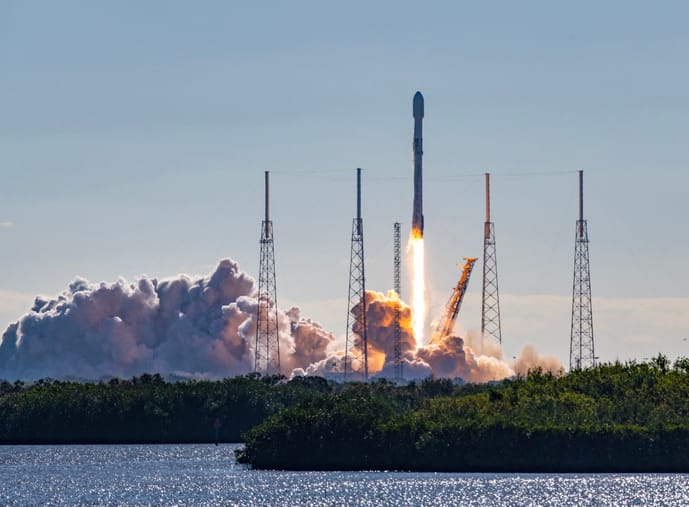
Space makes this visible because launches are countable. Starship Flight 13 flew yesterday, deploying 20 real Starlink satellites and putting the ship into the Indian Ocean intact and floating for the first time ever. Getting there took 13 full-stack test flights, several of which ended in spectacular failure. Ariane 6, Europe's flagship launcher and a capable piece of engineering, has flown seven times since its 2024 debut and hasn't lost one. Ariane 6 is a competent rocket. The difference is that SpaceX bought 13 flights' worth of knowledge about what actually breaks, and Europe bought seven flights' worth of confirmation that its design works.
Volume is what builds the wall
Then there's the second curve, the one I think matters more over a decade. SpaceX's own counters currently read 681 completed missions, 641 landings, and 604 booster reflights. The Block 5 booster was designed for 10 flights before major refurbishment. Boosters now routinely fly more than 25 times, with turnarounds as short as three weeks. Nobody engineered that improvement up front. It was discovered one component at a time, by flying enough vehicles enough times to learn what wears out on the 22nd flight rather than the 10th.
There's a well-established shape to this. Wright's Law, from a 1936 study of aircraft manufacturing, holds that cost falls by a roughly constant percentage every time cumulative production doubles. The improvement arrives per doubling, which means the return on any single additional unit diminishes as the total grows. Flight number 8 teaches you an enormous amount. Flight number 682 teaches you almost nothing by comparison.
That sounds like it should undercut the whole argument. It doesn't, because the compounding lives in how fast you traverse doublings in calendar time. SpaceX went from 8 flights a year to 165 while Ariane 6 accumulated seven flights total. Both improve by roughly the same percentage per doubling. One of them has collected several doublings in the time the other collected one, and each doubling starts from the improved position the last one produced.
Cadence creates the velocity of new knowledge. Volume creates the minutiae, and the minutiae are what become the competitive barrier.
A competitor can copy the Falcon 9 design. The blueprints were never the hard part, and anything written down leaks eventually, authorized or not. The layer that never gets written down is what stays put: which supplier's valve batch runs slightly out of tolerance, what the inspection routine catches on a 22nd reflight, how a launch crew reads an anomaly at T-40 seconds. That knowledge can only be acquired by flying, and flying requires demand a competitor hasn't got yet. Europe has the engineers. What it lacks is the flight rate, and without the flight rate, that talent gets far fewer chances per year to find out what it doesn't know.
Both curves run through AI, drug discovery, and advanced manufacturing the same way. Fail faster, fail in greater numbers, and only then do you get to succeed faster.
This is not the pace of ten years ago
What makes this urgent is how recently it changed. Falcon flew 8 times in 2016. It flew 91 times in 2023, 132 in 2024, and 165 in 2025, and passed 70 by the middle of this year. That's roughly a twentyfold increase in annual cadence inside a decade, in an industry that spent the prior fifty years treating a dozen launches a year as a serious operational tempo.
China is now doing the same thing, fast. On July 10 a Long March 10B first stage was caught in a net strung across a recovery ship in the South China Sea, four hooks snagging tensioned cables, no landing legs involved. It was China's first orbital-class booster recovery and it happened on the rocket's maiden flight, with plans to refly that same stage before the year ends. One catch against 604 reflights is not parity, and anyone claiming otherwise is selling something. It is entry into the loop, and the demand underneath it is explicit: China's Guowang and Qianfan constellations must place 10% of their planned networks in orbit by the end of 2026 to hold their international spectrum rights, and they're only a few hundred satellites in. That deadline is why reusability went from aspiration to requirement. Scale and national vision manufacture demand that private markets would take a decade to generate.
The AI picture rhymes. In one week this month Moonshot released Kimi K3 at 2.8 trillion parameters, the largest open-weight model yet built, and Alibaba previewed Qwen 3.8 Max. Independent evaluation puts K3 just behind the top American models and ahead of several of them on coding tasks. DeepSeek sells frontier-adjacent inference at 87 cents per million tokens against roughly $50 for the American flagship, which is a demand strategy as much as a pricing one: buy usage, generate the volume, feed the loop. When US export controls briefly cut foreign access to Anthropic's top models, a Chinese lab shipped a competitor days later with a pointed note that frontier intelligence shouldn't be subject to withdrawal at somebody's discretion.
Two accelerating competitors push each other harder than one running alone. Every Chinese release tightens American timelines, and every American constraint hands Chinese labs a market opening. Anyone still reasoning from a 2015 model, when the leaders and a capable second tier were separated by a few years of engineering effort, is working from obsolete assumptions. A well-run national program can still catch up given time and focus. What's in doubt is whether the doubling rate on the other side leaves enough calendar time to try.
The loop feeds itself
None of this happens by being granted a high cadence. It's earned, and then it self-reinforces. Arianespace's own CEO gave the honest answer in late 2025, asked whether the company could push past its planned launch rate. The constraint isn't engineering capacity, he said. It's customer demand. Ariane 6 could fly more often. Nobody's ordering enough launches to justify it.
That single comment is the whole mechanism in miniature. SpaceX earned a low cost per launch through years of iteration, which made it the obvious choice for anyone who needed something in orbit, which generated the order volume that funds the next round of iteration. A launch provider stuck at seven flights is locked out of the loop that would let it become faster, because the capital that would buy more cadence is waiting on the demand that only comes from already having it.
This is also why a popular recent ranking, countries by density of AI researchers per capita, measures the wrong thing. Switzerland topped that list. Switzerland also shipped a real AI model yesterday, the same day Starship flew: Apertus 1.5, from ETH Zurich, EPFL, and the national supercomputing centre at Lugano, built by an initiative with more than 800 researchers and 20 million GPU hours a year on a public supercomputer, released fully open source. The engineering is serious.
The capital is where it comes apart, and the scale shows up in the model itself. Apertus is a 70-billion-parameter model. Kimi K3, shipped a week earlier out of Beijing, is 2.8 trillion. Parameter counts flatter the Chinese models somewhat, since those designs activate only a fraction of their weights on any given token, but the gap in training investment behind the two numbers is real and it's roughly an order of magnitude. Twenty million GPU hours is a serious academic commitment sitting against $725 billion of demand-driven private capex, and that gap exists because the Swiss model has no demand engine underneath it. The Canton of Ticino uses a fine-tuned version to translate official documents. A medical variant is in testing at a Lausanne hospital. Both are respectable, and neither generates the daily volume that surfaces failure modes nobody anticipated, or the revenue that would justify the next order of magnitude in compute. Switzerland's 9 million people can concentrate excellent engineers and still never assemble the demand that turns a good model into a compounding one.
The tradeoff nobody voted on directly
Anything that caps demand or slows capital formation caps cadence. Regulatory environments that restrain how capital concentrates do it. So does social policy that directs capital toward broad security rather than concentrated risk-taking. Europe has chosen both, deliberately and at the ballot box, and the outcomes those choices buy are ones most people would endorse. The part that never appeared on any ballot is the second-order consequence: capital committed to the floor under citizens isn't buying cadence, and that amounts to an effective decision not to compete at the frontier. Reasonable people can make that trade. It's worth knowing you've made it.
A closing window
Nobody outside the loop is locked out permanently. But the window is closing faster than most policymakers have priced in, and Europe is only the nearest case. Most of the world is further out with fewer options.
What I keep circling back to is dependency. Anthropic's recent suspension of foreign access to its most capable models, overnight, on a US government export control directive, is the preview: whoever controls the loop controls who gets to use what comes out of it, and everyone outside discovers their position the morning it changes. Two countries are pulling away in space, in AI, and in everything built on top of both. Everyone else buys access to the output on terms they don't set.
Which brings me back to the cafés. When the loop isn't spinning where you live, the whole subject stays theoretical, right up until the morning somebody else's export control decides what tools you're allowed to open. My retired neighbors arguing on Nextdoor have more skin in this game than they know, and so do the people who weren't discussing it over dinner in Valletta.
So: what does a capable country that isn't the US or China actually do? Build a narrow domestic capability in one field and accept dependency everywhere else? Pool resources across borders and hope the politics hold long enough to matter? I can't find a third answer that isn't just a slower version of the second.