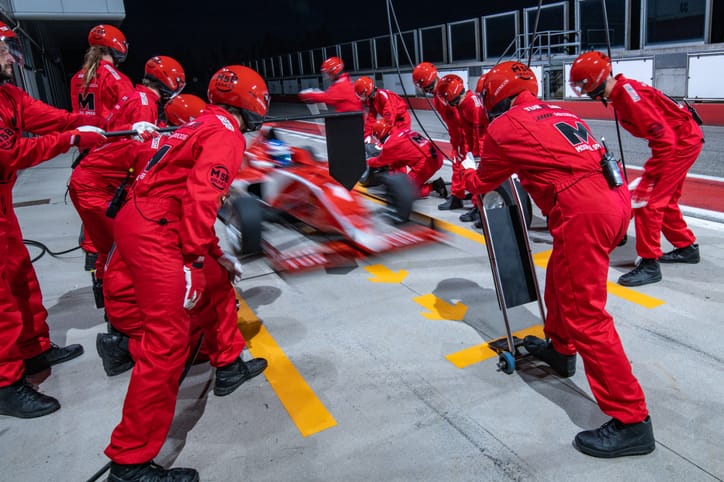
Oh good. Another lean blog post using Formula 1 pit stops as a metaphor. Quick changeover! Standardized work! Roles clarity! You've seen it a hundred times. I've written something like it at least twice. At this point the F1 pit stop is practically the clip art of the lean world, a visual shorthand so overused it's lost most of its meaning.
So bear with me, because I'm about to use it again. Only this time I want to talk about what lean practitioners almost universally missed when they borrowed the analogy. The pit stop metaphor turns out to be far richer than we made it, and a remarkable 2007 study out of Great Ormond Street Hospital in London proves the point.
Researchers at one of the world's premier pediatric cardiac surgery centers were trying to reduce errors during a specific, perilous moment: the handover of patients from the operating theater to the intensive care unit after complex congenital heart surgery. Think about what that involves. In roughly 15 minutes, a team transfers ventilation, monitoring lines, inotropes, vasodilators, and the entire accumulated clinical knowledge from a 4-8 hour surgery, all while the patient is at peak vulnerability. It is, essentially, a high-stakes, multi-system, multi-professional handoff under time pressure.
Sound familiar? It should. That's not just a pit stop. That's every inter-process handoff in every manufacturing or service operation.
Going to the Gemba
The researchers didn't watch a YouTube video of a pit stop and draw some parallels. They went to Maranello. Ferrari F1 invited the team to watch practice pit stops and conduct detailed discussions with the race director. Two aviation training captains also observed hospital handovers and provided additional input. This was genuine gemba, crossing industry boundaries to observe expert practice firsthand, not secondhand analogy.
What they brought back wasn't a stopwatch philosophy. It was a complete framework: defined leadership (a single coordinator with clear handoff authority), explicit task allocation, sequential phasing, structured communication discipline, checklists, situation awareness protocols, hierarchy-free escalation, and pre-handover briefing. If that list looks a lot like the Toyota Production System applied to information transfer, that's not an accident.
What Lean Actually Missed
When lean practitioners point to an F1 pit stop, they're almost always talking about SMED, Shingo's Single Minute Exchange of Die methodology, reducing changeover time by separating internal and external setup, standardizing tools, and simplifying fasteners. Valid and useful. But it's one thread from a much larger tapestry.
The hospital study surfaced what's actually interesting about a pit stop: the handoff architecture. Before each tire change, roles are assigned and understood. During the stop, communication is deliberately minimal so the choreography can execute without interference. The lollipop man (the coordinator) holds situation awareness while specialists execute narrow tasks. And critically, the team debriefs after every race to review what happened.
None of that is about speed. It's about reliability under pressure, which is a very different problem.
Compound Errors and Decoupled Failures
The most striking finding in the study involves what happened to errors after the new protocol was introduced. Before the new handover process, technical errors and information omissions were statistically correlated: when the equipment handover went badly, the information briefing also suffered. A poor technical handoff compounded into poor knowledge transfer, exactly the kind of error cascade that James Reason's Swiss Cheese Model describes. One hole aligned with another.
After implementing the structured protocol, that correlation disappeared. The protocol essentially decoupled the failure modes by sequencing them into distinct phases: equipment transfer first, information handover second, group discussion third. Even when one phase was imperfect, the others held.
In lean terms, this is poka-yoke logic applied to the transfer of tacit knowledge. The structure itself interrupts the defect propagation.
The Turnover Problem Nobody Talks About
There's one more finding worth pulling out, and it has direct implications for any lean practitioner trying to sustain standard work in a high-turnover environment.
F1 pit crews are remarkably stable. A team of roughly 20 people sees one or two changes per year. The researchers noted this explicitly as a key differentiator, because Great Ormond Street's ICU rotated six residents every three months, with a nurse turnover of approximately 10% annually. The protocol had to be designed for an inherently unstable team structure, trainable in 30 minutes or less at staff induction, documented on laminated sheets at each bedside. And it worked, with a 95% compliance rate on the pre-handover transfer form.
This is a lesson lean operations often dodge. Standard work is easy to sustain when your workforce is stable. The interesting design problem is building standard work that remains robust when it isn't, which is the actual situation in most hospitals, warehouses, call centers, and frankly most manufacturing facilities above a certain size.
The Analogy Was Always Bigger
The F1 pit stop metaphor earned its place in lean training because it's viscerally compelling. Eighteen people, seven seconds, zero mistakes. But that image tends to lock people onto the speed dimension, the changeover efficiency story, while the deeper lesson sits right next to it, largely ignored.
The deeper lesson is about what happens at the seams between processes, where knowledge, authority, and physical work transfer from one team to another. That's where errors compound, where tacit knowledge evaporates, where the next team inherits problems they weren't warned about.
So the next time someone in your organization uses an F1 pit stop to make a point about quick changeover, ask them a different question: what does your post-surgery handoff protocol look like?