When Prophets Look Like Madmen: Walter Russell and the Problem of Being Too Early
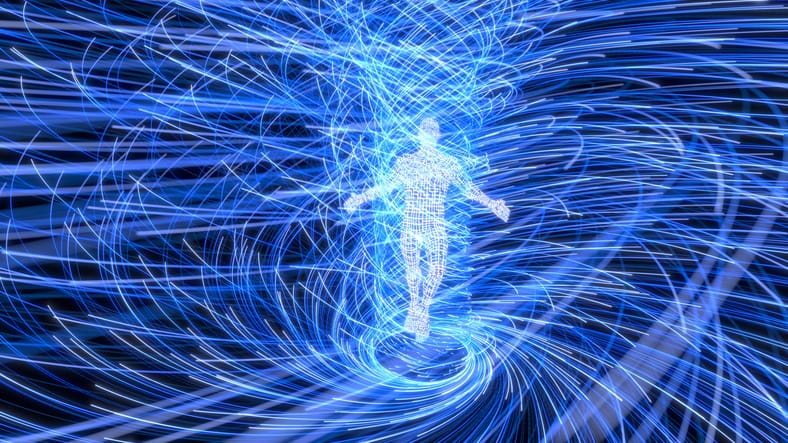
There's something unsettling about Walter Russell's story, and it's not what you might expect. In May 1921, this accomplished New York sculptor, painter, and architect (a man who had created portraits of presidents and designed $30 million worth of cooperative apartments) entered what his family feared was a psychiatric emergency. For 39 days, Russell remained in a trance-like state, claiming to access "the source of all knowledge." When he emerged, he frantically documented everything he'd experienced: philosophical and scientific revelations that would form his manuscript The Universal One.
He sent his findings to 500 leading minds of the time, and nearly all dismissed him as mad, except one. Nikola Tesla, perhaps the era's greatest genius, was so struck by Russell's insights that he urged him to seal the work away for a thousand years, insisting humanity wasn't ready for its truths.
That's the part that haunts me. Not whether Russell actually tapped into some cosmic consciousness, but the question of what we do with ideas that arrive before their conceptual framework does.
The Universe as Mind, Not Mechanism
Russell's core proposition was radical for 1926: matter wasn't solid but crystallized light slowed by thought. Everything around us, from rocks to human bodies, was composed of light patterns shaped by consciousness. He believed the universe was fundamentally mental, not material, and that all things moved in rhythmic cycles of expansion and contraction, like breath.
Reading this now, after decades of developments in physics and consciousness studies, something striking emerges: Russell was essentially proposing what contemporary philosophers call panpsychism, the theory that consciousness is a fundamental property of the universe, like mass or electrical charge.
This isn't fringe mysticism anymore. Consciousness is a fundamental aspect of reality, like mass or electrical charge. The idea goes back to antiquity. Plato took it seriously, and it has had some prominent supporters over the years, including psychologist William James and philosopher and mathematician Bertrand Russell. Philosopher Philip Goff's 2019 book Galileo's Error argues forcefully for panpsychism, and the theory has gained serious traction in contemporary philosophy of mind.
The key insight: maybe consciousness doesn't emerge from complex arrangements of unconscious matter. Maybe it's been there all along, and complexity just amplifies and organizes what was already present at the fundamental level.
From Mysticism to Mathematics
Here's where Russell's story gets interesting for those of us trying to connect dots across disciplines. When he claimed that "everything sought harmony and balance" and that reality operated through "rhythmic balanced interchange," he lacked the mathematical and conceptual tools to make these ideas testable. So they sounded like mysticism.
But consider neuroscientist Giulio Tononi's Integrated Information Theory (IIT), developed in the early 2000s. IIT suggests consciousness is integrated information, a fundamental quantity that can be measured mathematically. The theory entails that consciousness is a fundamental quantity, that it is graded, that it is present in infants and animals, and that it should be possible to build conscious artifacts. IIT draws an analogy between its identification of consciousness as a property of certain integrated information systems and physics' identification of mass or charge as a property of particles.
Russell claimed matter was "compressed light" and consciousness shaped physical form. IIT says the intrinsic nature of physical systems with sufficient integration is consciousness itself. The language is different, but the core intuition (consciousness as fundamental rather than emergent) is remarkably similar.
The Russellian Monism Connection
There's an almost eerie coincidence here. In contemporary philosophy of mind, there's a position called "Russellian monism," but it's named after philosopher Bertrand Russell, not Walter Russell. Yet both Russells arrived at strikingly similar conclusions about consciousness and matter.
Russellian monism (Bertrand's version) suggests that the intrinsic/concrete/categorical features of matter which physical science remains silent on actually account for the existence of consciousness. Physics tells us about the relational, structural properties of matter (what it does) but says nothing about what matter intrinsically is. Some Russellian monists think the intrinsic nature of fundamental matter is itself consciousness-involving.
Walter Russell, working independently and from a different starting point, proposed essentially the same thing: that what we call "matter" and what we call "mind" are two aspects of the same fundamental reality. He just expressed it in the language available to him in 1921, which made it sound mystical rather than philosophical.
When Light Becomes Consciousness
Russell's obsession with light as the fundamental substance of reality seems less strange when you consider modern physics and philosophy together. The fundamental constituents of reality (perhaps electrons and quarks) have incredibly simple forms of experience, and the very complex experience of the human or animal brain is somehow derived from the experience of the brain's most basic parts.
This doesn't mean rocks are pondering the meaning of life. It means that whatever property allows matter to give rise to consciousness might be present in rudimentary form at the most basic levels of physical reality, then becomes amplified and organized through complex structure.
Russell claimed "thought is the architect of form," that mind shapes matter through waveforms, and reality isn't built from atoms upward but projected from consciousness outward. Contemporary panpsychism phrases it differently: consciousness is intrinsic to fundamental particles, and the structures we observe emerge from combinations and integrations of these consciousness-bearing fundamentals.
Is this so different from quantum mechanics, where observation affects reality, or from IIT, where information integration constitutes consciousness?
The Electric Universe and Information Theory
Long before plasma physics began questioning standard cosmology, Russell proposed the universe was fundamentally electric in nature, not gravitationally driven as Newton and Einstein taught. He believed electricity was "a living spiral of energy, not merely electrons in motion," and that the vacuum of space was actually "a vibrant sea of untapped potential."
His unified theory posited that everything operated through "rhythmic balanced interchange," a constant pulsing dance of opposites he saw governing everything from atoms to galaxies. Today we might talk about wave functions, oscillating fields, field theories, and information states. The mathematics is more rigorous, but are we describing fundamentally different phenomena, or just using better tools to articulate what Russell intuited?
IIT, for instance, defines consciousness mathematically as integrated information (Φ), the amount of information generated by a complex of elements, above and beyond the information generated by its parts. When Russell talked about "rhythmic balanced interchange" as the organizing principle of reality, was he groping toward something like information integration without the mathematical framework to formalize it?
The Tesla Endorsement and Scientific Validation
Tesla's advice to lock the manuscript away for a millennium wasn't just dramatic flair. The legendary inventor genuinely saw something in Russell's work that he believed exceeded humanity's capacity to understand or accept. This raises an uncomfortable question: How many other ideas have we dismissed not because they were wrong, but because they were incompatible with our current conceptual frameworks?
Interestingly, while Russell's scientific theories were largely rejected during his lifetime, in 1941 the American Academy of Sciences conferred a doctorate on him after several laboratories isolated elements he had predicted: Deuterium, Tritium, Neptunium, and Plutonium. So he wasn't entirely wrong about everything. He just packaged his insights in language that made them sound like mysticism rather than physics.
Russell maintained that the fundamental divide between himself and mainstream science was about assumptions: he assumed the existence of mind as cause while he believed scientists assumed the existence of mind as effect. Now, three generations later, as serious philosophers and physicists entertain panpsychism and IIT, we're essentially revisiting Russell's core argument, just with better mathematics and less mystical terminology.
Why This Matters Now
The convergence I wrote about recently (between AI as prediction machine and brain as prediction machine) gains another dimension when we consider consciousness as potentially fundamental rather than emergent. If consciousness is indeed a basic property of reality like charge or mass, then:
- The "hard problem" of consciousness (how subjective experience arises from physical processes) might be asking the wrong question. We shouldn't ask how matter creates consciousness, but how fundamental consciousness becomes organized into complex experiences.
- Both biological and artificial intelligence might be ways of organizing and amplifying consciousness that's already present at some level in the physical substrate.
- The boundary between "conscious" and "unconscious" systems might be less binary and more about degrees of integration and complexity.
This doesn't validate every mystical claim or suggest rocks have inner lives. But it does suggest that Russell's core intuition (that consciousness and matter are two aspects of a unified reality) might have been pointing toward genuine insights that we're only now developing the conceptual tools to properly investigate.
The Language Problem
Here's the uncomfortable truth: we can't actually know if Russell accessed cosmic consciousness or experienced an extended altered state with religious overtones. The documented evidence suggests a highly intelligent, accomplished person had a transformative psychological experience and attempted to explain it using the conceptual tools available in 1921.
Those tools (mixing metaphysics, rudimentary quantum theory, and spiritual philosophy) produced something that sounded crazy to his contemporaries. But the underlying patterns he was trying to articulate? Those might have been genuinely insightful intuitions about the nature of reality, expressed through inadequate vocabulary.
This is the curse of being too early: you perceive the pattern before the paradigm exists to describe it. You're forced to use metaphor and mysticism because the precise scientific language hasn't been invented yet. And then people quite reasonably conclude you're either a genius or a lunatic, when the answer might be: someone who glimpsed something real but had to translate it through incompatible conceptual frameworks.
Consider how Russell's ideas map onto contemporary theories:
Russell (1921): "Matter is crystallized light slowed by thought. Consciousness is fundamental."
Modern Panpsychism: Consciousness is a fundamental property like charge or mass, present at all levels of reality.
Russell: "The universe operates through rhythmic balanced interchange."
IIT: Consciousness is integrated information, measurable as the causal power a system has over itself through feedback loops.
Russell: "Everything is composed of light patterns shaped by consciousness."
Russellian Monism: The intrinsic nature of matter, which physics doesn't describe, might be experiential/consciousness-involving.
The vocabulary has evolved. The mathematical frameworks have become more rigorous. But the core intuition? Remarkably persistent across nearly a century of development.
What We Do With Prophetic Intuitions
Russell's work is perhaps best viewed as an invitation to explore new ways of thinking about the universe and our place within it. Not necessarily as literal truth, but as intuitive pattern-matching that anticipated discoveries we're only now equipped to properly investigate.
The convergence between AI development, neuroscience, quantum mechanics, and consciousness studies suggests Russell might have been onto something with his emphasis on consciousness as fundamental, reality as information-based rather than purely material, and the universe as an integrated whole rather than dead mechanism.
He just expressed it in ways that made it sound like prophecy rather than hypothesis, mysticism rather than proto-science. Maybe the real insight isn't about whether Russell was right or wrong, but about recognizing that some intuitions precede the frameworks needed to test them.
Contemporary researchers are now seriously investigating questions Russell posed in 1921:
- Is consciousness fundamental or emergent? (Panpsychism vs. physicalism)
- What is the relationship between information, causation, and experience? (IIT)
- Can we quantify consciousness mathematically? (IIT's Φ metric)
- What is the intrinsic nature of physical reality beyond its relational structure? (Russellian monism)
These aren't fringe questions anymore. They're being addressed in peer-reviewed journals by respected philosophers and neuroscientists. The conversation has moved from "Is consciousness fundamental?" to "If consciousness is fundamental, how do we formalize that mathematically?"
The Pattern Across Time
Tesla thought humanity needed a thousand years before it could understand Russell's work. He might have been overly pessimistic, or maybe he understood that some ideas need multiple generations of technological and conceptual development before they stop sounding crazy and start sounding merely speculative.
Looking at Walter Russell's work now, I don't see a prophet or a madman. I see someone who had profound intuitions about consciousness, matter, and reality, expressed them using the inadequate language available at the time, and got dismissed by people who couldn't translate his metaphors into testable hypotheses.
But here's what interests me most: the pattern of ideas that sound like mysticism in one era becoming serious scientific inquiry in the next. Quantum superposition sounded insane until we could measure it. Curved spacetime seemed absurd until we could test it. The idea that time is relative rather than absolute contradicted common sense until Einstein formalized it mathematically.
Now we're watching consciousness studies undergo a similar transformation. What Russell expressed as "the universe is mental, not material" is being reformulated as "consciousness might be a fundamental property" and "integrated information constitutes experience." Same intuition, different vocabulary, one that allows for mathematical formalization and empirical investigation.
The real question isn't whether Russell accessed cosmic truth in 1921. It's whether his core intuitions (consciousness as fundamental, matter and mind as unified, reality as information rather than substance) are pattern-matches that we're now finally equipped to investigate rigorously.
Maybe Walter Russell was just someone decades ahead of his conceptual tools, trying to describe genuine insights using the metaphysical vocabulary available before information theory, before quantum mechanics was fully developed, before philosophy of mind seriously entertained panpsychism, and before neuroscience could formalize theories like IIT.
How many Walter Russells are walking around today, seeing patterns we won't recognize as valid for another century? And how might we better distinguish between genuine prophetic insight and well-articulated confusion when the language for testing hasn't been invented yet?
Sources: Wikipedia (Walter Russell), Non-Duality America, Dying Words, Goodreads, Unariun Wisdom, Polymathic Artist, Western Mystics, Fire Faith Fellowship, Substack, Wikipedia (Panpsychism), Stanford Encyclopedia of Philosophy (Panpsychism), Noema Magazine, Scientific American, Psychology Today, Nature Reviews Neuroscience, PubMed (IIT papers), PLOS Computational Biology