Chania's old harbor at sunset is the kind of view that makes you stop mid-sentence. The Venetian quay curves around still water, the lighthouse catches the last light, and somewhere behind you the White Mountains are doing the same. I've now seen a lot of Mediterranean harbors. This one lands just behind Dubrovnik on my all-time list, ahead of Valletta in Malta. Rhodes, which we visited next, would eventually pass it too. But Chania was the first place on this trip where I understood why people build entire vacations around a single old town.
Crete deserved more than a single town, though, and we split our time across two bases: five nights in Chania for the west, five in the Heraklion area for the east, a rental car the whole way. That structure made sense on paper. In practice it taught us something about the difference between an island that's mostly mountain and gorge and beach, and an island that's also the seat of Europe's first civilization. We could have easily filled seven or eight nights in Chania alone.
The Minoans, in brief
Before Greece was Greece, Crete was the Minoans: a literate, palace-building, plumbing-having society that ran from roughly 2700 to 1450 BCE. They built multi-story palaces at Knossos, Phaistos, and elsewhere, wrote in two scripts nobody has ever deciphered, and left behind frescoes of bull-leapers and blue dolphins that look like nothing else in the ancient Mediterranean. Linear B, a third script found at the same sites, turned out in 1952 to be an early form of Greek, written by the Mycenaeans who took over the palaces after the Minoans collapsed. The collapse itself lines up suspiciously well with the Thera eruption on Santorini, though current scholarship treats that as a contributing factor rather than the whole story.
Then everyone else showed up. Romans, Byzantines, Arab raiders who held the island for over a century, a Byzantine reconquest, four centuries of Venetian rule, and finally the Ottomans after a 21-year siege of Heraklion, one of the longest in history. Each layer left something standing. You can see all of it in a single afternoon walk through any of the island's old towns, which is the real argument for visiting Crete over almost anywhere else in Greece: the density of legible history per square kilometer is absurd.
Chania: the one that earns the postcards
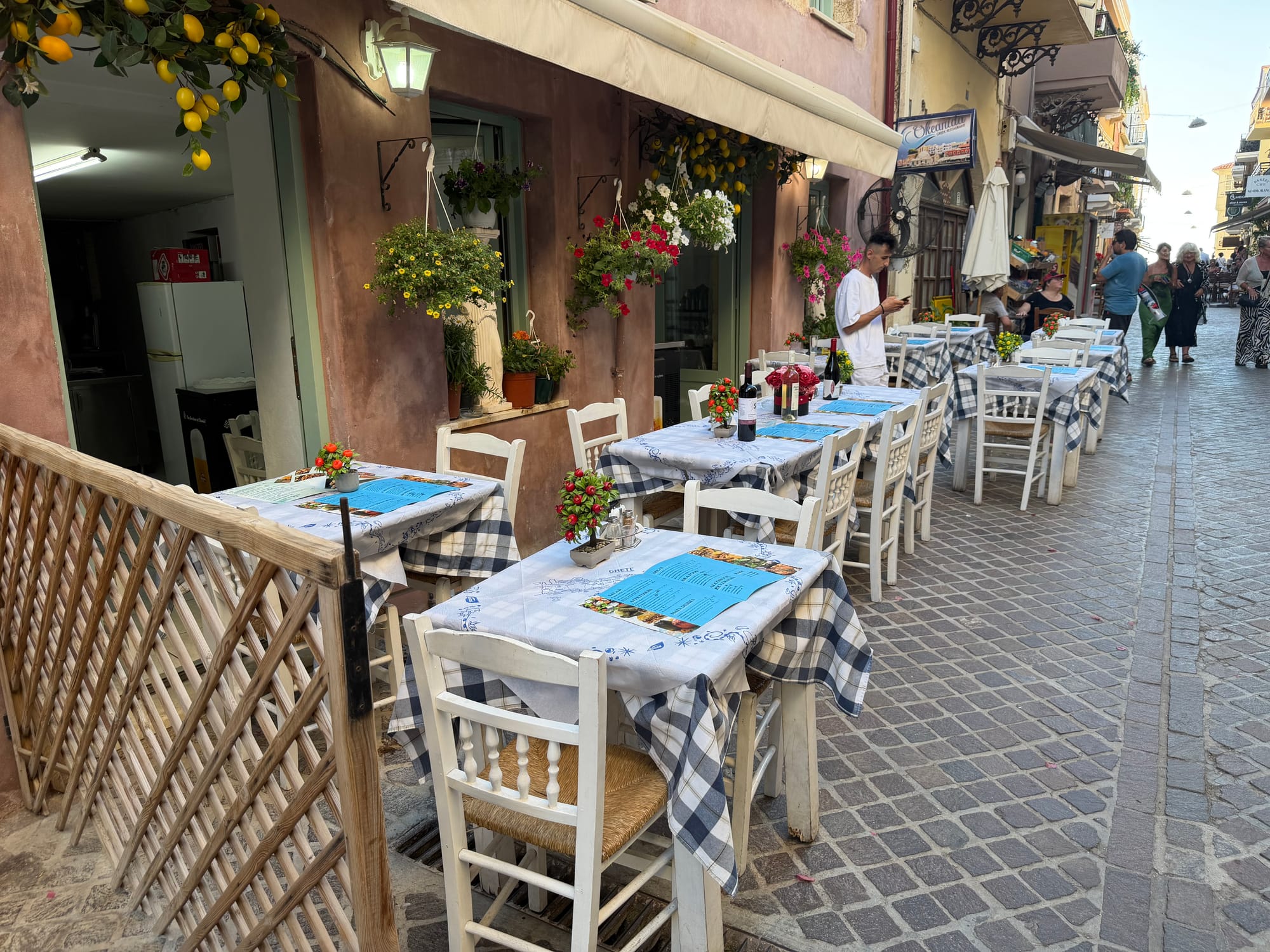
We taxied into Chania old town on day one specifically to avoid the parking hassle, a decision I'd repeat. The harbor itself was built by the Venetians in the 14th century, and the lighthouse at its tip was rebuilt by the Egyptians in the 1830s, an odd little detail that nobody mentions until you're standing in front of it. We went back for meals multiple times just to sit at the water and watch the evening crowd drift by. That's the whole experience in one sentence: find a table, order something, watch the harbor do its thing.
The road trip days were just as good. We drove to Elafonissi first, an hour and a half from Chania, and the locals were right to push us toward an early start. Parking and beach chairs there are genuinely limited, and the lot was jammed by 10am. After a couple hours there we continued another hour to Falassarna, which had plenty of space even in early afternoon, a nice reminder that the busiest beach isn't always the best one. We skipped Balos entirely. Both locals and hotel staff warned us off the access road, an unpaved stretch with potholes deep enough to do real damage to a rental car, and a damaged rental car is not how you want to spend a vacation day.
Arkadi, and the seam between Crete's two halves
The drive from Chania to Heraklion on transfer day runs through Arkadi Monastery, and it's worth the stop even though the last couple kilometers have signage bad enough to test your patience. The monastery's 1587 Baroque facade is striking against the plain hills around it, but the building isn't really the point. In November 1866, during the Cretan revolt against Ottoman rule, roughly a thousand rebels and civilians took refuge inside the walls. When Ottoman forces breached them, the defenders ignited the gunpowder magazine rather than surrender. The explosion killed hundreds of people on both sides and became the symbol of Cretan resistance across Europe. Standing in that courtyard, knowing what happened there, is the kind of humbling that no museum placard quite manages to deliver on its own.
Arriving in greater Heraklion afterward is its own kind of whiplash. Chania is compact and walkable. Heraklion is large, industrial, and bustling in a way that feels like a different country, and our hotel was another 20 minutes past the city itself.
Heraklion: worth it, but not the same trip
Knossos lived up to its billing. Get there early, which by now should be the refrain for every site on this island, and the crowds stay manageable. The drive in was easy. Later, driving into and parking in Heraklion's old town was its own small puzzle, solved by the large, easy P1 or P2 lots near the port and a ten-minute walk in. The old town itself, though, was a letdown after Chania's harbor. Still worth a single visit, just not a place we returned to for dinner the way we did in Chania. The Archaeological Museum, on the other hand, earns every minute you give it: the original Knossos frescoes, the Phaistos Disc, gold jewelry that makes you wonder what else got lost. Book both Knossos and the museum two weeks ahead if you want your preferred entry time. They sell out.
The unambiguous highlight of the eastern half was Spinalonga, a fortified island the Venetians held until 1715 and that later became Europe's last active leper colony, operating until 1957. The boat from Plaka takes ten minutes and costs ten euros, with twenty more for entry, and it's both shorter and easier than the Elounda alternative. Walking the old patient settlement inside those Venetian walls, knowing people lived entire lives there in quarantine, is the kind of history that doesn't need embellishment. After the island we drove through Elounda and down to Agios Nikolaos, where cafes ring a small inland lake that opens to the sea. Parking there was genuinely difficult, the one knock on an otherwise pleasant stop.
We'd planned a day trip to the Lassithi Plateau, the upland plain where myth places the birth of Zeus, but the heat made the call for us and we stayed local instead. That turned out to be the wrong kind of relaxing.
The hotel problem
The Domes Noruz in Chania was excellent: boutique, adults-only, sort of W-hotel sensibility, a good beach a short taxi ride from old town, a very nice spa. It also had a quirk I'm still puzzling over: the bathroom sink sat outside the bathroom in the middle of the room, water arriving via a long pipe dropping from the ceiling. Watching your partner stand there as the room's centerpiece, waiting for the temperature to stabilize on its long trip down, was an experience I'll politely call unique. Hotels shouldn't try this hard to look trendy. The room doors were thin enough that bar crowds returning at 1 or 2am woke us most mornings, and the gym was basic past the essentials, but the staff was fantastic and clearly tried to please us throughout the stay. Unlike the Amirandes, we'd go back.
The Amirandes near Heraklion was a different story. On paper it's a five-star resort with strong reviews. In practice it had a distinctly different vibe, and a vegetarian dinner that wasn't a sixty-euro buffet plate of bad pizza and questionable sushi turned out to be hard to find. But the real issue was the volume of children, babies included, filling spaces that are usually adult by hotel convention: the bars, the single large pool (babies in questionable diaper… gross…), areas where you'd reasonably expect some quiet. We'd stayed at plenty of five-star resorts with kids around and never had this problem, because the adult spaces actually functioned as adult spaces. Here they didn't. We ended up leaving two days early, even with no refund on the unused nights, and flew on to Rhodes ahead of schedule.
If we did Crete again, we'd shift the balance west: more time in Chania, less in Heraklion, and a hotel search that actually screens for boutique adults-only before booking. None of that diminishes the island itself. Four thousand years of continuous civilization, two of the great Minoan palaces, a fortress that held the Ottomans off for two decades, and a lagoon-blue beach an hour from a mountain gorge: Crete earns its reputation. Just choose your second base more carefully than we did.