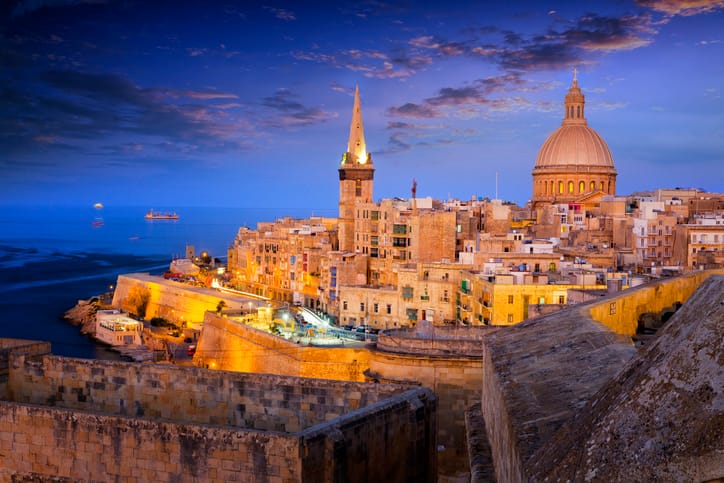
We’re a week into a month-long trip through Malta, Crete, and Rhodes. This is the first of three posts, on Malta, a place that surprised me.
Getting to Malta was easy. We flew United nonstop from San Francisco to Zurich then connected to Swiss Air for the hop to Malta. Zurich has long been my favorite European connection, a quietly excellent Star Alliance hub with none of Frankfurt’s sprawl or Munich’s terminal chaos.
The Phoenicia Malta is our benchmark for the rest of the trip. It’s a luxury hotel in every sense, but what makes it work is the location: literally steps from the old city gate, which means you walk into Valletta for dinner and walk back whenever you like. The rooms are genuinely quiet despite the city setting, the gym is well-equipped (opens at 7am, which is a mild disappointment when jet lag has you up at 2am), and breakfast covers every possibility between buffet abundance and made-to-order. The real showstopper is the garden and infinity pool perched alongside the old city walls, looking out over the harbor toward Sliema.
Valletta
The city is small enough to walk end to end in 20 minutes, which is either a limitation or a gift depending on what you’re after. We found it a gift. The whole peninsula is a UNESCO World Heritage Site, and the density of what’s packed into it, St. John’s Co-Cathedral with its Caravaggio canvases, the Grand Master’s Palace, the Barrakka Gardens with their harbor views, rewards the unhurried approach.
One logistics note worth passing on: check the cruise ship schedule at cruisemapper.com before planning your day. Valletta and the Three Cities get overwhelming fast when more than one ship is in port. Early morning and after 4pm are reliably calmer. We learned this by experience, and adjusted accordingly.
Getting up and down between the waterfront and the city level is handled by the Barrakka Lift. 1 euro, runs every five minutes, no meaningful wait. The down trip is often included. It’s a small thing, but it makes the waterfront feel connected to the city rather than separate from it.
On our first full day we explored Valletta on foot, then took a traditional dgħajsa, a pointed wooden water taxi with one oarsman standing at the stern, across the Grand Harbour to the Three Cities. Five minutes across the water, and you’re in Birgu’s medieval streets, which haven’t changed much in plan since the Knights were there. The Inquisitor’s Palace is the only intact judicial complex of its kind in the world; the Gardjola sentry box at Senglea’s tip frames a perfect view back to Valletta.
The second day we took the Hop-On Hop-Off bus, which has become our favorite way to get an overview of a new destination. Malta’s HoHo is one of the most comprehensive I’ve encountered anywhere. The blue north route is far better than the red south — the south overlaps substantially with the Three Cities area we’d already covered, while the north runs through territory you won’t otherwise see. We didn’t get off at stops; the 3.5-hour loop was enough. It functions as an orientation that makes subsequent exploration more deliberate.
Beyond Valletta
Malta is diverse enough that staying in Valletta and calling it done would be a real mistake. On separate days we took Bolt to Hagar Qim and Mnajdra on the southern cliffs, to Mdina, and on Sunday to the Marsaxlokk waterfront market.
Hagar Qim and Mnajdra are more impressive and more affecting than the Gozo temples. They’re older than Stonehenge by a thousand years, and the precision of Mnajdra’s solar alignments where the rising sun at the equinoxes illuminates the central altar through the main threshold is one of those facts that refuses to settle comfortably. Both are covered by fabric canopies now, which is the right call for limestone preservation and a mild aesthetic concession.
Mdina is the Silent City: population around 300, no cars, Norman-Baroque palaces, and an almost total absence of noise. The contrast with Valletta’s evening animation is striking. After all the harbor views, it’s also good to be on high ground looking inward across the island. Fontanella Tea Garden on the bastion wall is the natural stopping point.
The beach towns on the north and northeast coast have a completely different energy — upbeat, party-forward, reminding us of Punta del Este versus Montevideo if you want a reference point. Worth seeing for the contrast alone, and the HoHo covers them.
Gozo
The original itinerary had us doing Gozo the complicated way. The better answer is the Gozo Highspeed Ferry from Lascaris Wharf at the base of Valletta’s walls, one short walk from the Barrakka Lift. It runs hourly on the :45, takes 45 minutes, and leaves the taxi-and-slow-ferry logistics behind entirely.
One practical note: booking online was repeatedly declined by my Visa. “Gozo Highspeed” apparently pattern-matches to fraud. Amex is accepted almost nowhere except major hotels. The fix is to buy tickets at the terminal window, where the physical card went through without issue. Round-trip is cheaper than two one-ways; book the return for a late slot, since they’ll let you board an earlier ferry if there’s space.
In Gozo we skipped the HoHo as reviews suggest it’s unreliable and used Bolt instead. Never waited more than 5 minutes, marginally more expensive, worth it entirely. The day’s sequence: Ggantija temples, the Victoria Citadel, lunch in Victoria center, Bolt to Ramla Bay (Gozo’s wide arc of orange-red sand), then back to the harbor for the ferry.
Ggantija is the oldest of the Maltese temple complexes, predating the main island temples by several centuries. The site museum has improved substantially in recent years and is worth the time before you walk into the stones. Victoria’s Citadel has the additional story of its trompe l’oeil cathedral ceiling. Gozo couldn’t afford a dome, so they painted one, which is either charming or melancholy depending on your perspective.
A few general notes
Both Uber and Bolt operate in Malta, with many drivers running both apps simultaneously. Bolt is significantly cheaper with near-identical experience, vehicles, and wait times, just a lower fare. Download and set up the Bolt app before you arrive. It’s also one of the few vendors outside the hotels that takes Amex. Tipping isn’t expected but is appreciated, particularly at restaurants. One catch: paying by Visa at most restaurants leaves no way to add a tip on the terminal, so keep a few coins or small bills on hand. ATMs are plentiful throughout.
The harbors are worth a slow look for reasons beyond the scenery. The number of yachts, including serious mega-yachts, parked in the various ports is remarkable. One moored in the Three Cities harbor caught my attention; a quick lookup revealed it chartered at $900,000 per week. Good to know the other half is doing fine.
Early June weather was essentially perfect: low 80s, low humidity, no rain. The sun, though, is stronger than it feels. We watched a steady stream of sunburned tourists who apparently disagreed. Hat, sunscreen, water. Prices in Malta are noticeably lower than Greece, which we discovered the following week. Valletta’s outdoor dining scene is lively well into the evening with a diverse crowd, easy to find a table on a side street and watch the parade go by.
Malta surprised me by being more layered than I expected. You can cover Valletta in a day or two and feel like you’ve seen Malta. You haven’t. The temples, Mdina, the beach towns, and Gozo are distinct enough that they feel like separate countries stacked on 316 square kilometers of limestone. That density is the whole point.
Crete is next.