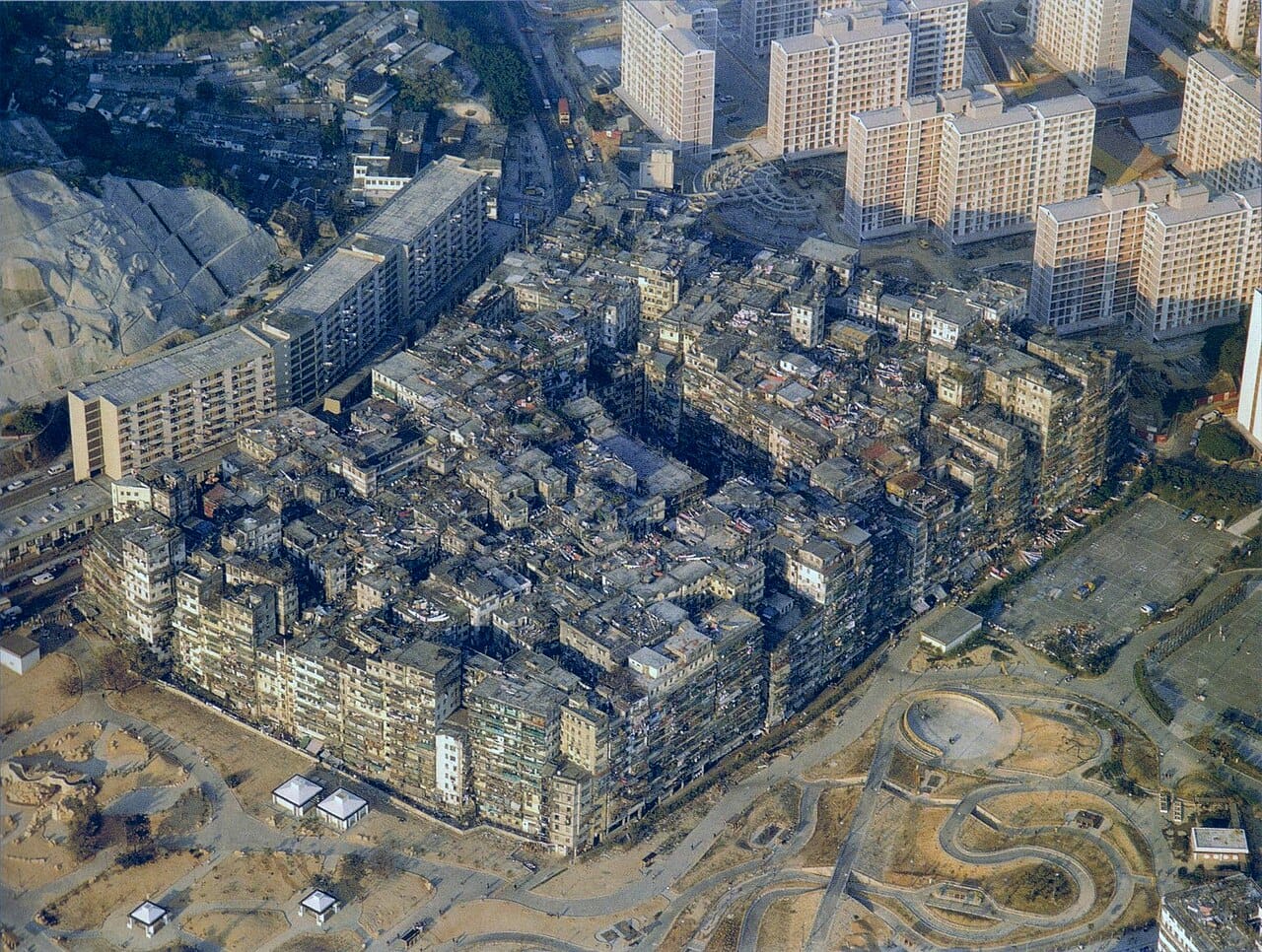
One of the genuine pleasures of retirement is that a random Reddit post can consume your entire morning without guilt. That's exactly what happened when I stumbled across a thread on Kowloon Walled City, a dense urban settlement that occupied a single hectare in Hong Kong from roughly 1946 until its demolition in 1993. I went down the rabbit hole and came back with something I wasn't expecting: a surprisingly coherent argument about management, hierarchy, and human social resilience.
The Accidental City
Kowloon Walled City was, at its peak, the most densely populated place on earth, with somewhere north of 50,000 residents packed into a footprint about the size of a city block. It grew not from any plan but from a geopolitical accident. China, Britain, and Hong Kong each had a claim on the site after World War II and rather than sort it out, all three governments simply walked away. No taxes. No building codes. No regulations of any kind.
Buildings went up haphazardly, then got connected. Gaps left for ventilation became stairways; stairways linked buildings; buildings merged into a single continuous structure. You could traverse most of the city without touching the ground, navigating a three-dimensional network of corridors and bridges that nobody designed and everybody used. Photographer Greg Girard and architect Ian Lambot documented it extensively in their 1993 book City of Darkness, and Japanese researcher Kazumi Terasawa's team produced detailed architectural drawings that remain the primary academic record.
What the architectural record doesn't fully capture is the social structure, which is where it gets genuinely thought-provoking. Before Hong Kong's anti-corruption commission cleaned things up in the 1970s, the triads ran Kowloon Walled City. But their governance was functional in a way that surprises people. They enforced strict internal rules: no robbery of neighbors, no harassment of women, no preying on the community that sustained them. Ordinary crime was rare. Neighbors were close. Order emerged from conditions that should have produced chaos.
The Organizational Parallels
Academics have reached for Deleuze and Guattari's rhizome theory to describe KWC's structure, which is a fancy way of saying it was non-hierarchical and multidirectional rather than top-down. KWC self-organized around competence, reputation, and mutual dependency rather than positional authority. Elinor Ostrom, who won the Nobel Prize in economics for showing how communities govern shared resources without collapsing into the tragedy of the commons, would have recognized the pattern. KWC developed, informally, most of the conditions she identified as necessary for self-governance: clear membership, local rule-making, and mechanisms for resolving conflict.
This brought me directly to a factory I wrote about several years ago that operated with almost no management titles. The only person called "manager" was the plant manager, in charge of the plants, as in the greenery. Sun Hydraulics, a $170 million hydraulic components manufacturer in Florida, ran on a flat organizational model where peer acceptance substituted for formal authority, hiring filtered for collaborative self-starters, and culture enforced norms that policy manuals usually fail to reach.
The structural parallel between KWC and Sun Hydraulics is striking. Both arrived at functional order through the same mechanism: remove formal hierarchy, and social systems organize around trust, competence, and interdependency. Both were bounded systems, KWC by physical walls and Sun by a strong cultural membrane around hiring. Where the analogy gets interesting is where it breaks down. Sun's model works in a stable, skilled workforce with careful cultural selection. KWC absorbed refugees, criminals, and desperate immigrants with no filter whatsoever, and still self-organized into something functional. The forcing function wasn't cultural fit; it was survival interdependency. When you cannot avoid your neighbors, you figure out how to get along.
The Uncomfortable Thesis
Formal hierarchy may not be the natural state of human organization. It may be a compensating mechanism for insufficient trust and social density. When you have the right conditions, bounded environment, genuine interdependency, strong informal culture, management structure becomes overhead. Most organizations invest heavily in management precisely because they haven't built the culture that would make it optional.
KWC was demolished in 1993, its residents relocated, the buildings razed. A park now stands on the site, pleasant and well-maintained and completely forgettable. But the 50-year experiment it ran raises questions nobody has fully answered: what conditions allow self-governance to work in one setting and fail in a comparable one? How much of what we call "management" is actually solving problems that a different culture would never have created?
And here's the conjecture I'll toss out and let you argue with: if human civilization ever did hit a serious reset, the evidence suggests we'd figure it out. Not elegantly, not without conflict, and probably with some triads involved. But 50,000 people once built a functioning society from scratch in a building with no exits that anyone planned. That's not nothing. It might actually be everything.