Rotating Emergency Inventory: What Japan's Vending Machines Actually Do in an Earthquake
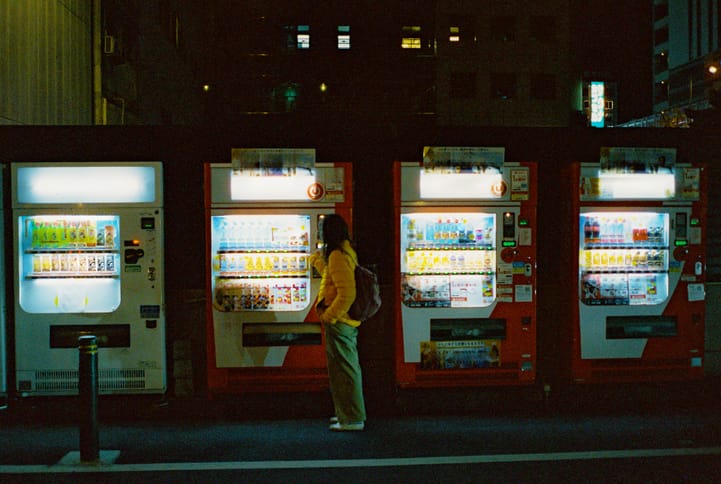
A magnitude 7.1 earthquake hit Kumamoto Prefecture a couple weeks ago. Within a few hours came the usual flood: drone footage of a partially collapsed shopping mall, a paper mill chimney down in Yatsushiro, tsunami advisories issued and lifted, and a rising tide of confident explanation from people who have never set foot on Kyushu.
One item caught my eye, because I've been to Japan several times and the vending machines always amazed me. The variety especially, and the placement: mountain trails, alleys with no store within a mile (hot canned coffee in winter is one of civilization's better ideas). The claim making the rounds was that Japanese machines open up and go free during an emergency, and that most carry a QR code you can scan to tell responders exactly which ruined street you're standing on.
Half of that is wrong and the other half is half right, about the hit rate I'd expect from a comment thread 6 hours after a disaster. What's actually there is better than the story.
What's actually there
The QR code doesn't exist, at least not for that. The codes on machines report a jam to the operator so they can mail back your 150 yen. What does exist is older, dumber, cheaper, and much harder to break. Since 2005 the vending machine industry has worked with police and fire departments to put address stickers on machines nationwide, so that someone calling 110 or 119 can say where they are. Japanese street addressing is notoriously hard to read off a wall, and official emergency guidance now lists the sticker alongside utility pole numbers as a fallback locator.
No power, no network, no phone battery, no app. The internet upgraded a sticker into a smart system, which is backwards, because the sticker is the design that still works when everything else is down.
The free vending is real and rarer than advertised. Coca-Cola started installing disaster machines in 2003, controlled remotely over the network and mostly carrying storage batteries so they run through an outage. After the 2011 Tohoku quake the company switched about 400 of them to free and gave away more than 88,000 drinks. Many others open with a physical key switch, which means somebody has to show up and turn it. Machines that decide on their own are new and scarce: two of them in Ako City, installed in 2023 near evacuation shelters, holding about 300 drinks and 150 emergency food items, tripping open at shindo 5 or higher.
The kanban card on the sidewalk
In 2008 I toured Toyota's Kyushu complex in Miyawaka, in one of the prefectures under an emergency warning today. The plant was running 1,150 vehicles a day across two shifts, mixed model, and there was not a computer visible anywhere on the assembly floor. Parts bins moved on paper kanban cards. I flew 5,000 miles to watch cardboard rectangles tell a factory what to build, then walked out past the machines I'd been buying coffee from all week without recognizing the same idea in a different housing.
An emergency stockpile is dead stock. You buy it against a forecast, warehouse it, pay to hold it, and find out on the day you need it that the elastic has rotted. A disaster vending machine holds the same goods as live inventory on continuous rotation, funded by ordinary commerce and restocked by a route driver whose income depends on it being full and working. As the Mainichi noted about the Ako machines, since they sell normally the rest of the time, nothing expires and nothing goes to waste. The carrying cost goes negative. The stockpile turns a profit while it waits.
Taiichi Ohno got the pull system from watching American supermarkets restock shelves according to what customers took off them. Japan ran the loop back the other way and turned the supermarket into civil defense.
What dead inventory looks like
After Katrina, FEMA was hammered for failing to get supplies to people, so in 2006 it bought enormous quantities of food and ice and positioned them across the Southeast. The season came in mild. Millions of prepared meals spoiled in trailers parked in the Gulf Coast summer, where FEMA workers clocked interior temperatures above 120 degrees, and the agency discarded 279 truckloads of food. It also held 84.9 million pounds of leftover Katrina ice for that same season, then paid roughly $67 million to store and destroy it.
FEMA's deputy director explained the logic with more candor than most: "we didn't want to run any chance of running out." That is a forecast-push system talking. Nothing in normal operations touched the inventory, so nothing in normal operations reported that it had gone bad.
I should mark the limit before I oversell this the way that comment thread did. You will never find a ventilator in a vending machine. Rotation works only where commercial demand and emergency demand overlap. That overlap is unglamorous and larger than people assume: water, food, ice, batteries, fuel. It also happens to be the first 72 hours, which is the window Tokyo's refuge parks are explicitly sized for.
Past that you're into the long tail, where there's no commerce to borrow and you pay for dead stock deliberately. Japan solved the first three days by noticing that a solution was already standing on every corner, funded by thirsty commuters. The long tail is still a problem, there and here.
Hikarigaoka Park hides cooking stoves inside 36 of its benches and emergency toilets under 52 of its manhole lids. MIT's Miho Mazereeuw, whose Design Before Disaster came out this spring, makes the point that everyday use is what builds the mental map: people know where to go in a crisis because they've already had a good time going there.
Several commenters on that thread asserted that yakuza groups own a chunk of Japan's vending machines. I looked and found nothing. Documented organized crime fronts run to construction, waste disposal, entertainment, and labor dispatch, so I'd treat it as folklore until somebody produces a source.
What is thoroughly documented is that the gangs show up. In 1995 the Yamaguchi-gumi ran meals out of its Kobe offices and used boats and helicopters to get around blocked roads. In 2011 the Inagawa-kai moved 25 four-ton trucks of diapers, ramen, batteries, and flashlights within a day, and over 100 tons in all. They turned up in Kumamoto in 2016 too. A retired Hyogo prefectural detective put the motive plainly: it's tradition for the Yamaguchi-gumi to expect a return on its charity. Stationary bandits protect the territory they collect from. Resilience running on self-interest again, in a form nobody would have designed on purpose.
Japan's soft drink machine count fell to 1.95 million in 2025, under 2 million for the first time in 30 years and about 20 percent off the 2014 peak. Ito En has gone from 165,000 machines to roughly 75,000 in a decade, and Sapporo left the business entirely. The cause is dull: price inflation and driver shortages.
Nobody voted to shrink the emergency water supply. That's the quiet failure mode of dual-use infrastructure. When the paying use dies, the second job goes with it, and it never shows up on anyone's preparedness budget because it was never on anyone's preparedness budget to begin with.
Which leaves me with two questions. What are we already decommissioning by accident while congratulating ourselves on the efficiency? And what's standing on our streets right now that could be doing a second job?