Some of my best trips have been the least planned. On a Wednesday in mid-February, my wife and I looked at an open week ahead, a forecast of heavy rain at home, and asked ourselves the obvious question: where can we go? By Friday we had nonstop air tickets from SFO, a room at the Mandarin Oriental, and a housesitter for the cat. Forty-eight hours from idea to airport is not our normal operating mode, but it worked beautifully. Taiwan became my 70th country visited, and it earned its place near the top of the list.
One thing we completely missed in our rush to book: we were landing on Lunar New Year Eve. A quick note on terminology -- in much of the West this gets called "Chinese New Year" (CNY), but in Taiwan and other Asian countries the preferred term is Lunar New Year (LNY), since the holiday long predates modern China and is celebrated across many cultures. Either way, it is the biggest holiday in Asia, roughly equivalent to Christmas and Thanksgiving combined.
This turned out to be both a complication and a gift. The complication: many restaurants were closed the first two days, shops shuttered, and the Hop On Hop Off bus we often enjoy the first day for orienting ourselves in a new city wasn't running. The gift: Taipei, normally a city of 2.6 million, was eerily quiet and calm as residents traveled to visit family. Traffic was minimal, crowds nonexistent. We'd recommend timing a visit around LNY with eyes open – just book restaurants in advance and don't count on the HoHo bus. When it finally did run on day three, it was the worst we've experienced in any major city – few stops, minimal commentary. Skip it. Uber is cheap, easy, and gets you where you want to go.
The flight itself was a reminder of how comfortable modern long-haul travel can be in a flat-bed seat -- 14.5 hours westbound, 11.5 hours on the return thanks to the jet stream. The Mandarin Oriental delivered everything we've come to expect from an Amex Fine Hotels and Resorts property: airport pickup, exceptional breakfast, outstanding afternoon tea, and a spa that turned our Lunar New Year Day -- when essentially everything in the city was closed -- into one of the most relaxing days we've had in years.
Jet lag hit us a day or two in, as it always does, but morning gym sessions helped. The gym is solid if not exceptional; the mix of Technogym equipment common in Asian and European hotels is not my preference, but the free weights were good.
Taipei surprised me with its modernity and order. Having visited Bangkok, Saigon, and other Southeast Asian cities, I expected more urban chaos. What I found instead was a clean, well-organized, and remarkably easy city to navigate. There's data behind that impression: Taipei consistently ranks among the top five safest large cities in the world.
I appreciate that more than most, because one of my favorite ways to experience a new city is long evening walks with no particular destination. Taipei rewards that completely. One Uber driver made the point more bluntly -- he noted, with a knowing smile, that people in Taipei don't have to worry about being shot. An obvious dig at the U.S., and not an unfair one.
We started sightseeing at Longshan Temple, then up to the City God Temple, followed by a walk along Dihua Street, a historic, authentically local stretch of dry goods shops and traditional Chinese medicine dealers that felt genuinely lived-in rather than curated for tourists. The temples ranged across Buddhist, Daoist, and folk religious traditions, and were active with worshippers observing LNY. One detail that stuck with me: the offering tables outside were stacked with large boxes of Pringles alongside the traditional fruit and incense. Faith adapts.
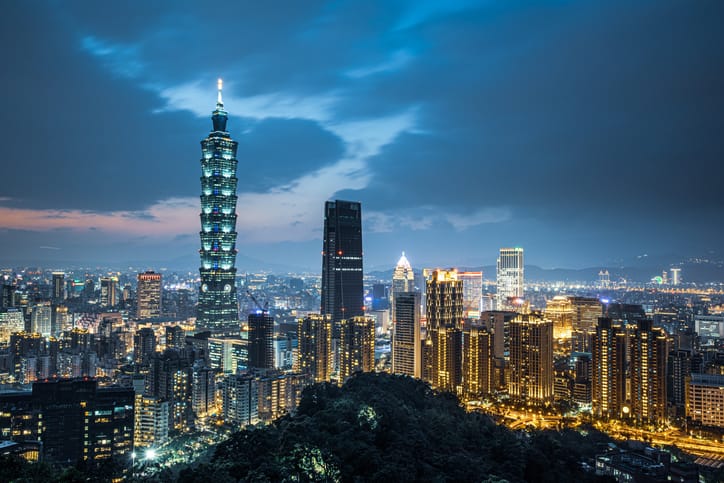
From Cisheng Temple and its surrounding food market we Ubered to Taipei 101 for the observation deck on the 89th to 91st floors. The engineering highlight inside is the 660-ton tuned mass damper ball, designed to counteract wind sway – a remarkable piece of applied physics hanging in plain view. The views of the city are excellent, though I'd argue the view from nearby Elephant Mountain is more memorable. The 600-step climb to the summit is steep but manageable, and looking back at Taipei 101 framed against the skyline is one of those images that stays with you.
The National Palace Museum deserves significant time. One of the largest collections of Chinese antiquities in the world – over 695,000 artifacts – only a few thousand are displayed at any one time. The backstory is extraordinary: when the Nationalists retreated to Taiwan in 1949, they brought the cream of the Forbidden City's collection with them, effectively preserving it from what followed on the mainland during the Cultural Revolution. It's a complicated history, and standing there you feel it.
The Chiang Kai-shek Memorial is worth visiting for similar reasons -- monumental, beautifully maintained, and historically layered. CKS himself was a complicated figure, autocrat and cultural preservationist simultaneously. The National Theater and Concert Hall flanking the memorial plaza add to what is genuinely one of the more impressive civic spaces I've visited.
For food, the Raohe Night Market is mandatory. Chaotic and crowded in the best possible way – orderly chaos, consistent with Taipei's character – with every conceivable street food on offer. We passed on the pig blood cake and squid on a stick, but the flavored waffles and fresh fruit juice blends were excellent.
Yangmingshan National Park was a day-trip highlight: volcanic steam vents, cherry blossoms in bloom (mid-February is peak), and beautiful grassy volcanic highlands above the city fog. Four hours by private taxi is the right move -- easier and cheaper than a tour.
And then there is the reason I most wanted to visit Taipei now. Taiwan sits in one of the world's more precarious geopolitical positions, and I wanted to see it before anything changes. My wife was more nervous about the timing than I was. The locals we spoke with were remarkably calm, less fatalistic than philosophical, as people tend to be when they've lived under an ambiguous threat for 75 years.
Part of what makes Taiwan's position so distinct is immediately visible on the street: Taiwan feels like free market capitalism in full expression, and it felt genuinely different from the state capitalism of mainland China and Vietnam. Big billboards, luxury goods stores, open-air vendors, independent shops competing loudly for attention. You see similar commercial energy in China and Vietnam, but something feels fundamentally different there, markets permitted and directed by the state, always operating within boundaries set from above.
In mainland China especially, and to a lesser extent Vietnam, there's a background hum of surveillance, of being watched and measured, that shapes how people carry themselves in public. Singapore offers an interesting non-communist variation, genuinely free markets and strong rule of law, but operating under what scholars call soft authoritarianism, where political dissent is quietly but effectively managed. Taipei has none of that ambient pressure. The energy feels genuinely open in a way that's hard to quantify but easy to sense if you've spent time in the others.
What I wasn't prepared for was how little I actually understood the full situation despite following it from afar for years. This is the whole point of lean thinking – you go to the Gemba, the actual place, and you see, listen, and ask questions with humility. You cannot understand a factory floor from a conference room, and you cannot understand Taiwan from a think tank in Washington.
Standing in the National Palace Museum, looking at artifacts that survived one political upheaval and could potentially face another, I realized how much nuance gets lost at distance. What worries me is that the people making decisions about Taiwan's future, on all sides, may be operating with the same deficit of ground-level understanding that I had before I arrived. The people, the culture, the history, the feel of a free society, they are not abstractions. Go see for yourself, while you can.